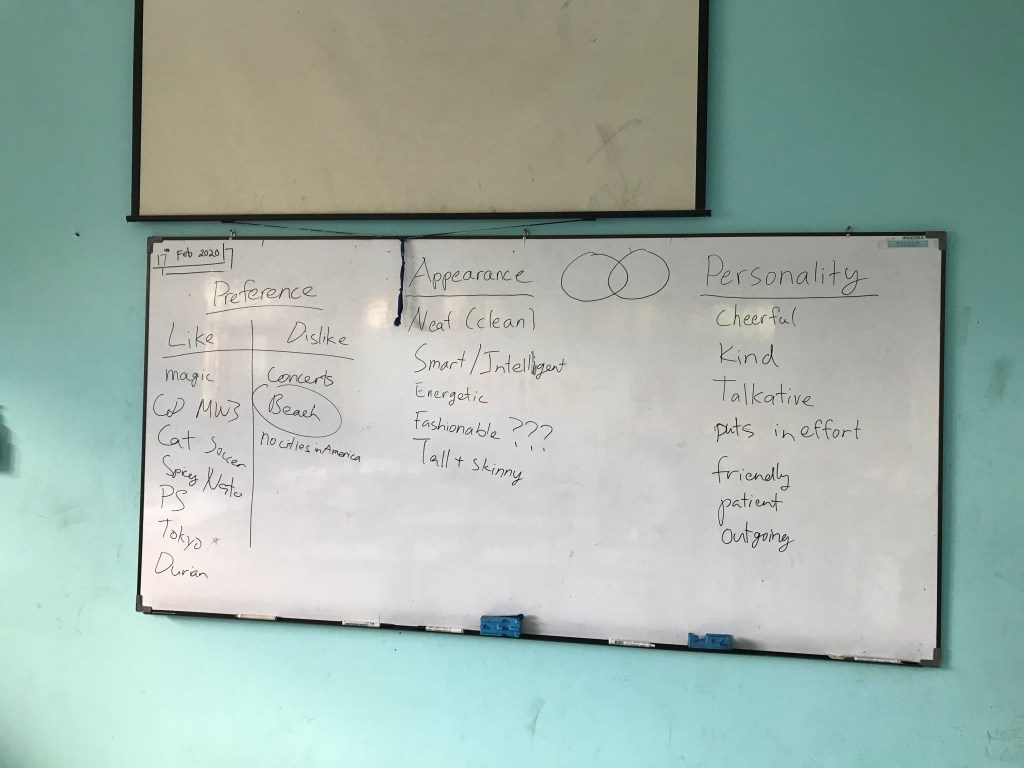
The week of 2/17-2/21 was the first official week of teaching Practicum. It was also the first time I was able to use the teaching plan I made myself. This week’s lesson was on describing people: personality, appearance and preference. The lesson plan can be found here.
Procedures of Teaching
Classes are generally around 30 students, where the majority of issues lies with keeping students engaged for the entire 70 minute block. I first start with some conversational topics and jokes for the first 2 minutes as students settle in after break. Then, I take around 3 minutes to do a quick review of topics from the last class. Since this lesson has a day 1 and day 2, the second lesson is a review on what we covered on the first day as well as a talk about the homework.
Next, I head into the Introduction of the day’s lesson. Day 1 was an explanation of Appearance, Personality, and Preference followed by an exercise where students describe me. Day 2 is a longer introduction where I introduced new vocabulary and phrases for students to learn how to talk about themselves. The most important part of the introduction is to give students a chance to learn about the new topic as a class. I choose students to answer and try to give them all a chance to make sure they are all engaged.
After, I create a development period for the students to consider these skills on their own. This either comes from group work or individual work. Group work is based on writing down their thoughts and answers to a task I give, then sharing answers as a group to the class. Individual work is grammatical writing, where they try to answer in paragraph form a task that I present. Either way, this allows them to practice the topic I just covered with the class.
I then do a short review of what was just covered. If there is time, I invite some students to present their individual works. If it was group work, I try to lengthen the time by asking additional questions where possible. Last, I give an overall recap of the things we covered in class and assign them an easy homework assignment due by next class.
Time Management and Organizing Activities
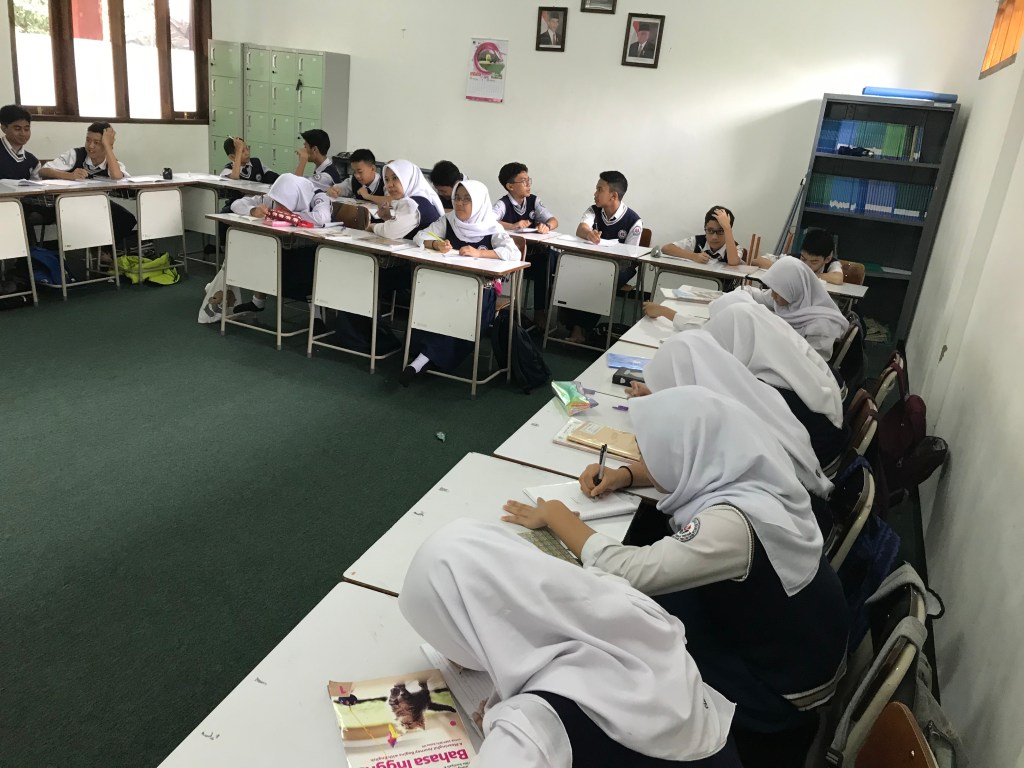
One of the greatest issues with teaching is the time limit on every class. Although 70 minutes may sound like a lot, it rarely is enough. Time management for me is based on what I have already dictated on the lesson plan: usually a 25-minute introduction, 30-minute development task, 5-minute review, 5-minute explanation of homework, and 5-minute cool-down period.
This time breakdown is kept on a timer on my smartphone to make sure I’m on track. Although classes don’t usually follow such a strict timeline, I can be flexible with development task or introduction time in order to ensure understanding of any material covered. The most important part of organization is not allocate strict time, but to help understanding in that time. If one student does not understand a part of the introduction, they will slow down all in development.
In this week, I developed a simple but effective clapping game to keep all students attended on me. I would clap twice and follow it with them students clapping back twice. The number of claps would change and they would do so too. This becomes a short-term fun game that lasts no more than 10 seconds.
As this teaching plan has a lot of exercises, I try to make time for each. However, in the event each cannot happen, I focus on writing and group based tasks. What I deem to be more beneficial to students (such as the writing task about family members) is what I give more time to.
Classroom Management
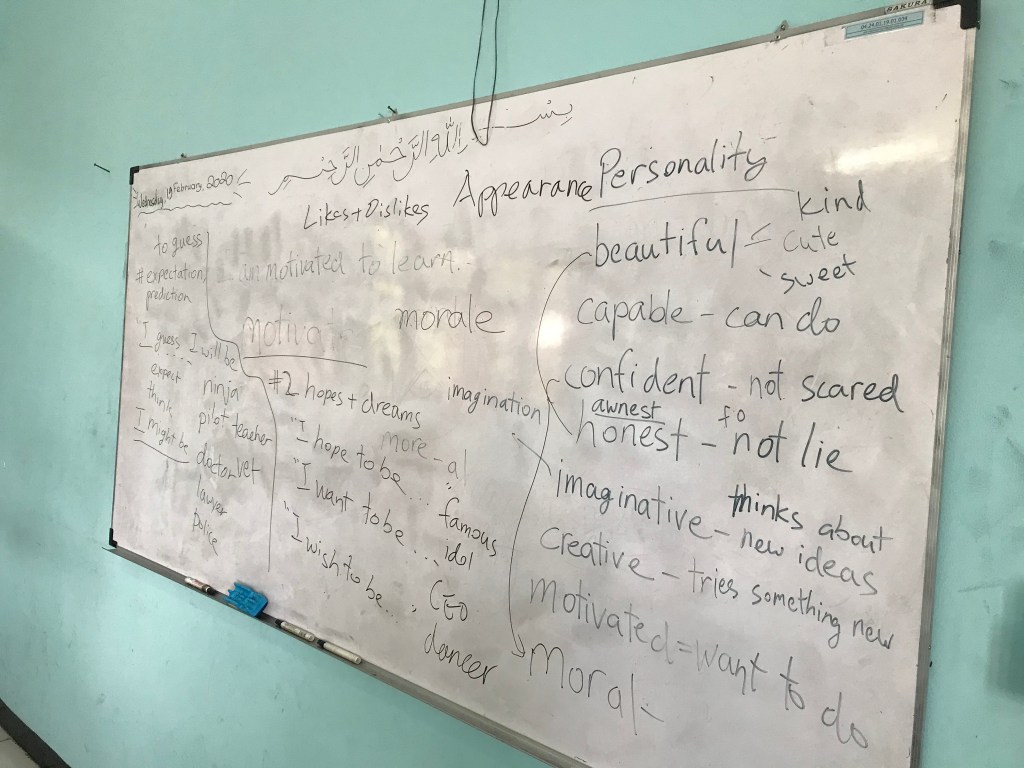
Students already have their seats, so I did not have to worry about seating charts or names. However, as these are junior high students, they are prone to talking among themselves and not paying attention. In order to combat this, I use the clapping mechanism mentioned above. For introduction lessons, I also make students repeat key phrases and vocabulary under the guise of a pronunciation check, but it also doubles as a way to see which students are looking up and paying attention rather than looking down.
In situations where students have a good reason not to listen (such as illness), I make sure to treat it as an individual case. For example, one female student had a stomach ache while in class and could not participate in lectures. I made sure to approach her, find out what’s wrong, provide comfort, and allow her time to rest. I believe that trust is what’s important to make the other students believe they can pay attention genuinely.
Problem Solving While Teaching
As with any ESL, the biggest issue is when students do not understand what you are saying in English, but can communicate in their mother tongue. Thus, students help students, but they don’t necessarily learn English this way. I realized this issue after teaching a few classes, and this behavior continues. However, to combat this I decided to choose students directly in an energetic manner rather than just point at whomever. I do this to show an enthusiasm and expectation that they can answer. Most of the time, they do try. During times they cannot answer, I either move on, or ask the class for their input on this question in order to help that student.
Other problems arise when tasks and instruction are not understood. I have slowly tweaked the lesson over the multiple times I teach it in order for my word choice to be simpler, clearer, and easier to understand. I start to talk slower and repeat myself more. Although some students feel annoyed, because all students in the class are not of the same level, the performance overall has greatly improved.
I give plenty of positive reinforcement to students since many have not studied English extensively, before. However, when they do not pay attention or are being disruptive in class, I do not hesitate to discipline. I make sure to connect with students based on hobbies and interests outside of class, so the discipline can be felt coming from an authoritative rather than an authoritarian perspective. Gaining the trust of students was crucial for being able to control them in the classroom.

 Brian's Indonesia SEAMEO