I was only able to use Teaching Plan #3 once due to time constraints on the course. However, I was able to use it on a total of 2 classes, giving it one trial run and one semi-refined run. As this teaching plan is simply a review of topics already covered, my assessment of it will be short.
Generally, a review teaching plan tries to go over what students should know already. In the west, students would be able to take out self-written notes to go over as the teacher speaks. However, Indonesian students are in an environment where taking notes while the teacher is talking is seen as disrespectful (this piece of advice came straight from my supervising teacher), thus many of them do not have resources to pull from again. It is then safe to assume that many students have forgotten what was covered and how to do it.
In the units I taught, I generally used a deconstruction bullet point format to illustrate ideas of Descriptive text. It was good to see that many students remembered how the general format was, but had forgotten the details. I had to very quickly run through all the ideas again, but students were generally quick to catch back on. Although this is a good way to think about English in writing, I wonder how well it will help them on tests.
The biggest issue I had with this lesson was the time constraint, more so than other lessons. Because I was set on a 70 minute limit to cover 3 weeks worth of content, I had to be sure my timer was set for 20 minute periods. However, the trial lesson definitely went over and I couldn’t cover the last unit. The refined lesson was much better, and students got a review of grammar, thought process, and vocabulary in the time limit.
Students being loud were once again controlled by hand gestures rather than words. It seemed to be more effective when they gave their own interpretation of what being loud meant rather for me to reprimand them. Sometimes, I gave them a chance to be loud, which seemed to help them concentrate for a slightly longer period of time.
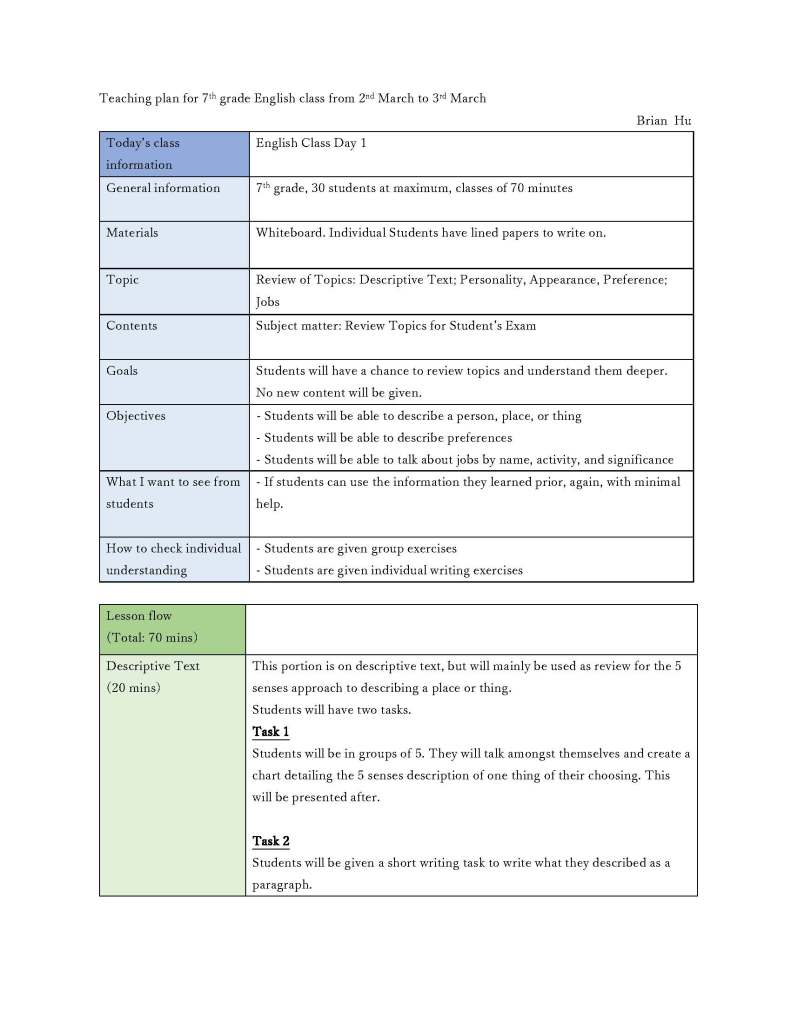
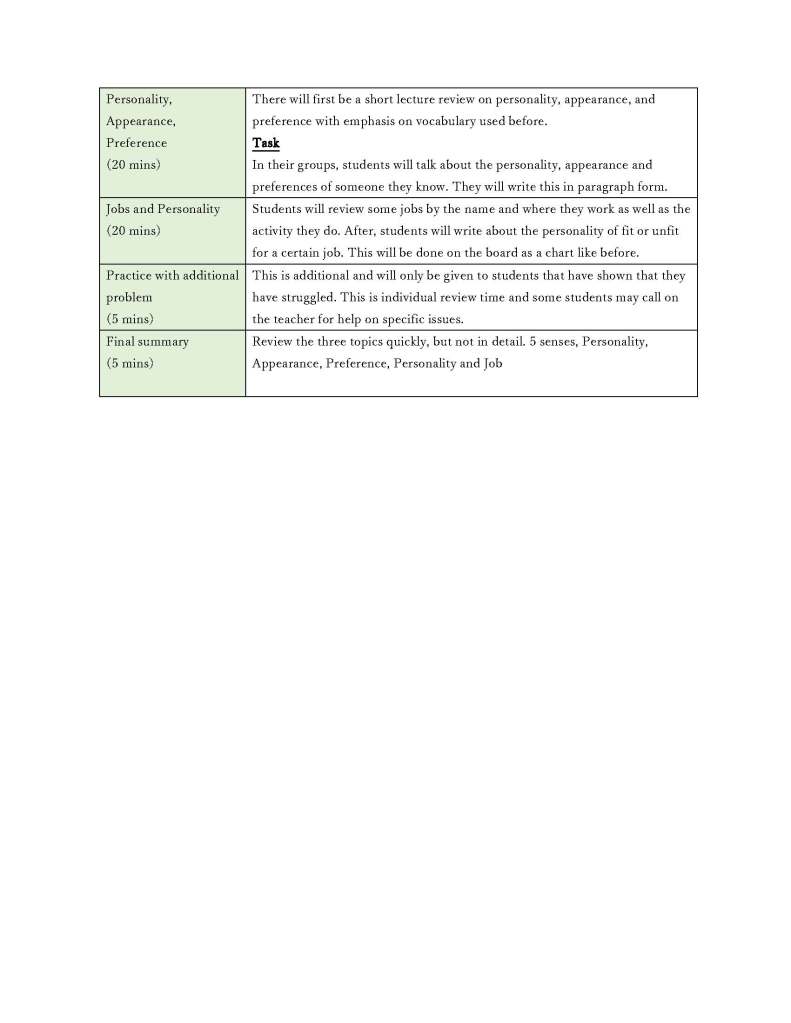
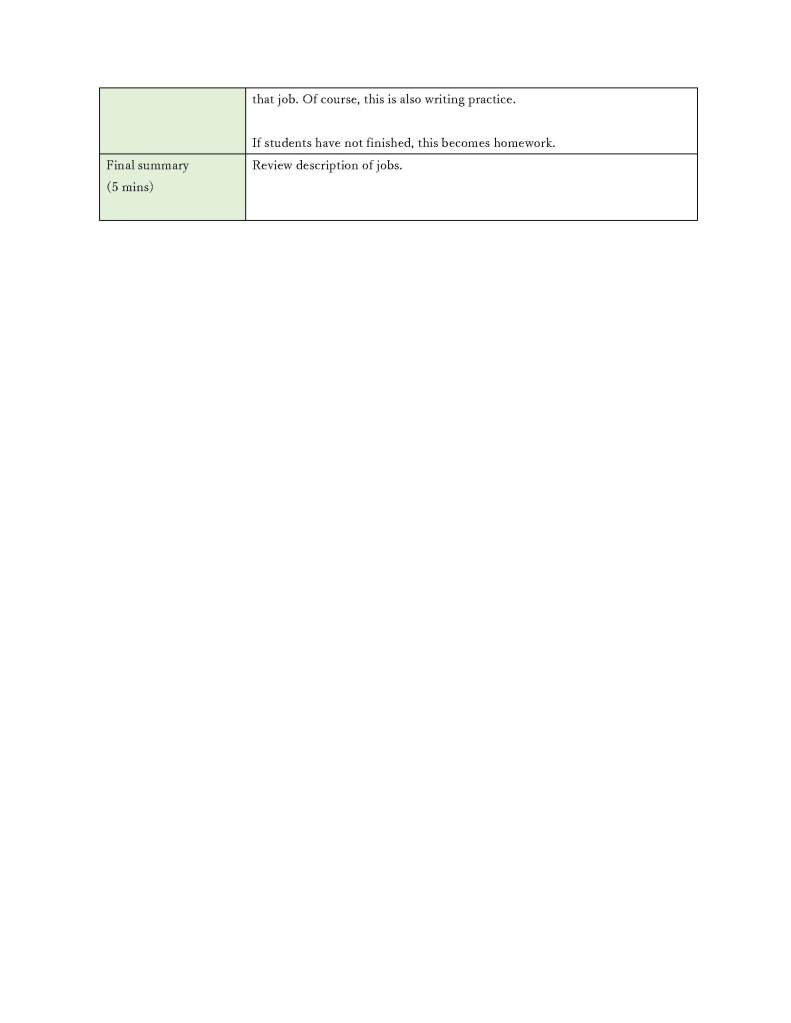
Teaching Plan #3 is to be used on the 2nd and 3rd of March. These will be the last two days of my teaching and will not have any new content. Instead, these classes will be used as a review for the student’s exam happening the following the week. Thus, there is not much to say about this teaching plan.
Curriculum The curriculum is the same that has been used so far. That is to say, Descriptive Text for people, places and things. For people that includes personality, appearance, and preferences. Last is about jobs, which gives students a chance to talk about jobs in English as well as personality traits that fit and don’t fit different jobs.
Teaching Plan 70 minutes is all I have for each class, so it will be split by 20 minutes of review for each topic. It will focus on the 5 Senses way of description, describing people by Personality Appearance and Preference, and Jobs and Personality. Some summarizing together will make this 70 minutes, enough of a review for students to remember the content.
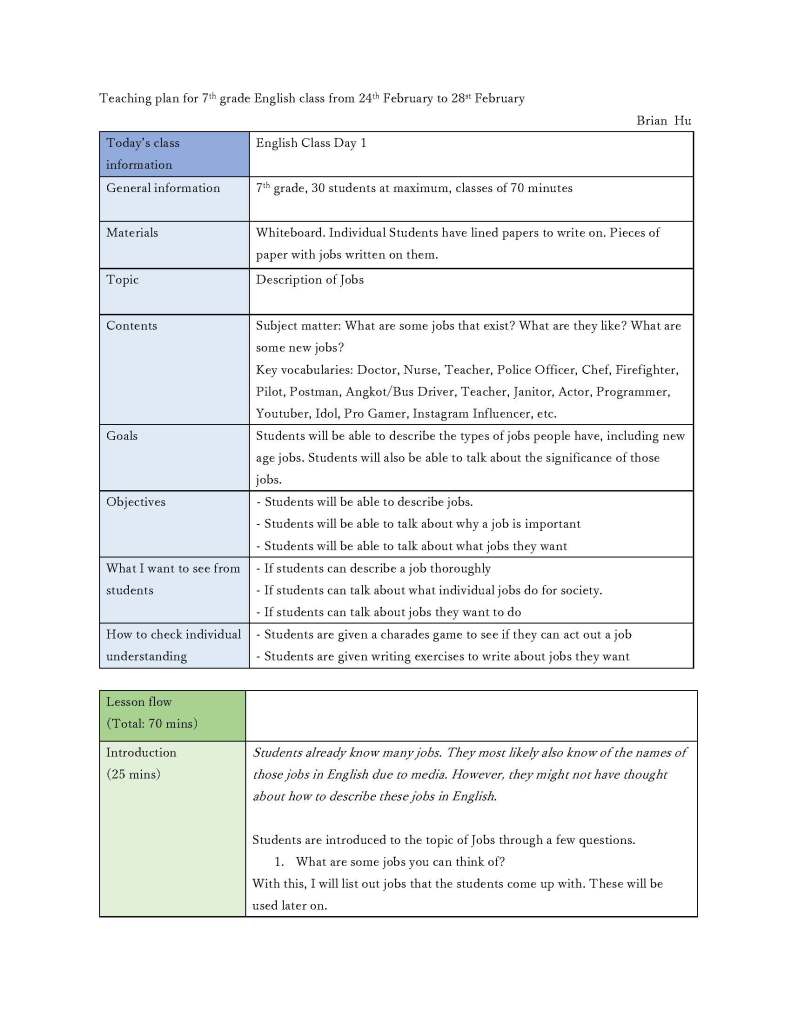
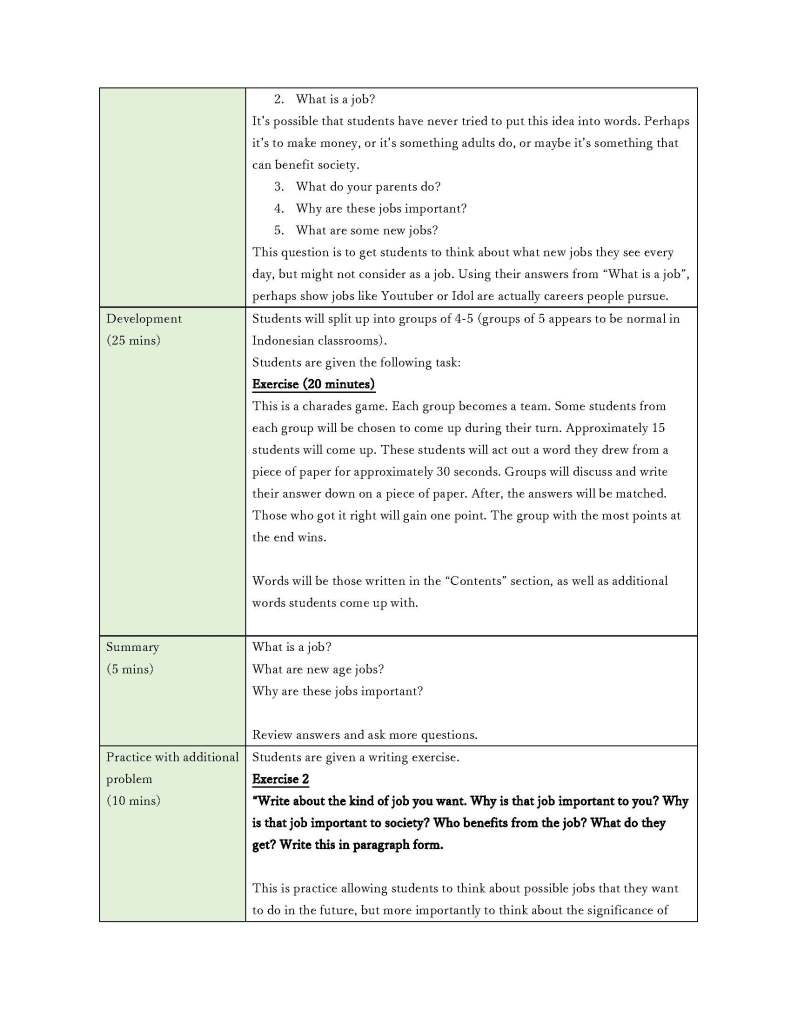
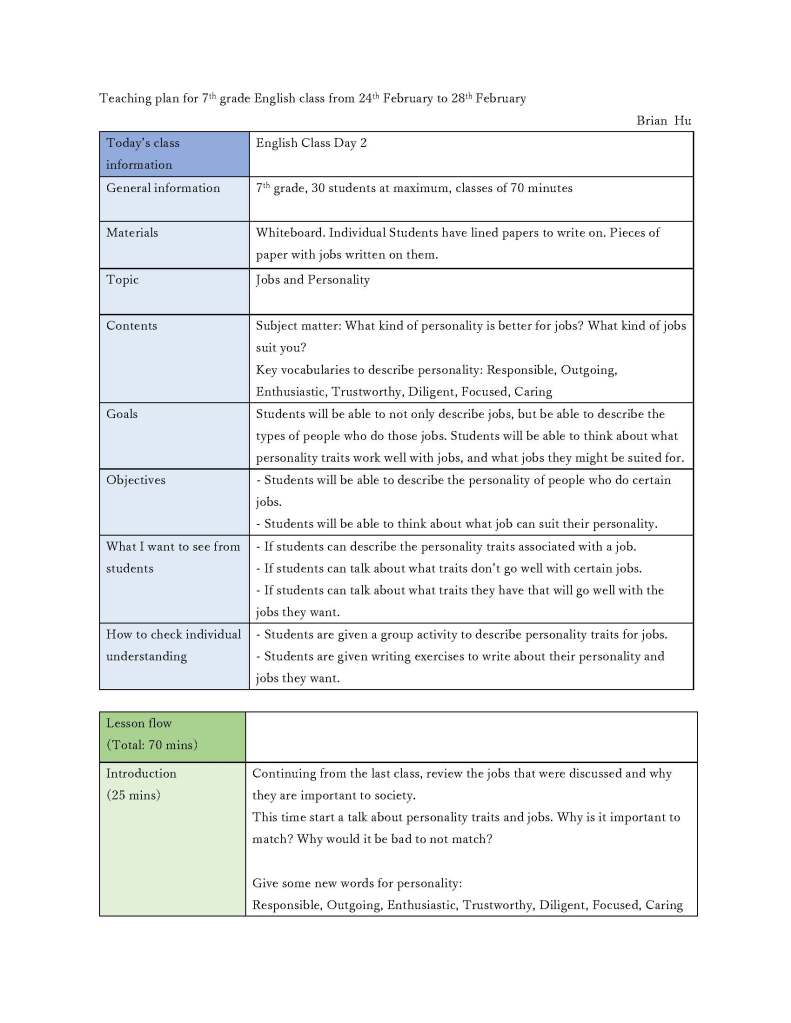
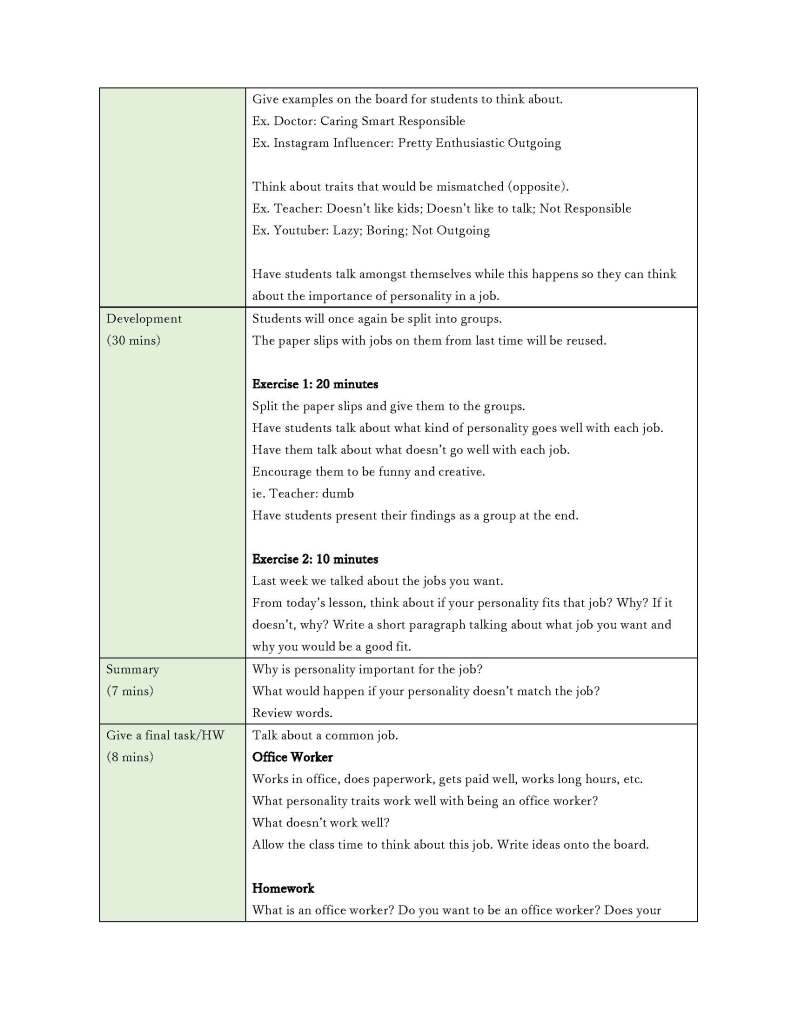
The week of 2/24 to 2/28 was the second full week of teaching with a teaching plan. The topic of this week was on jobs, and the said teaching plan can be found here.
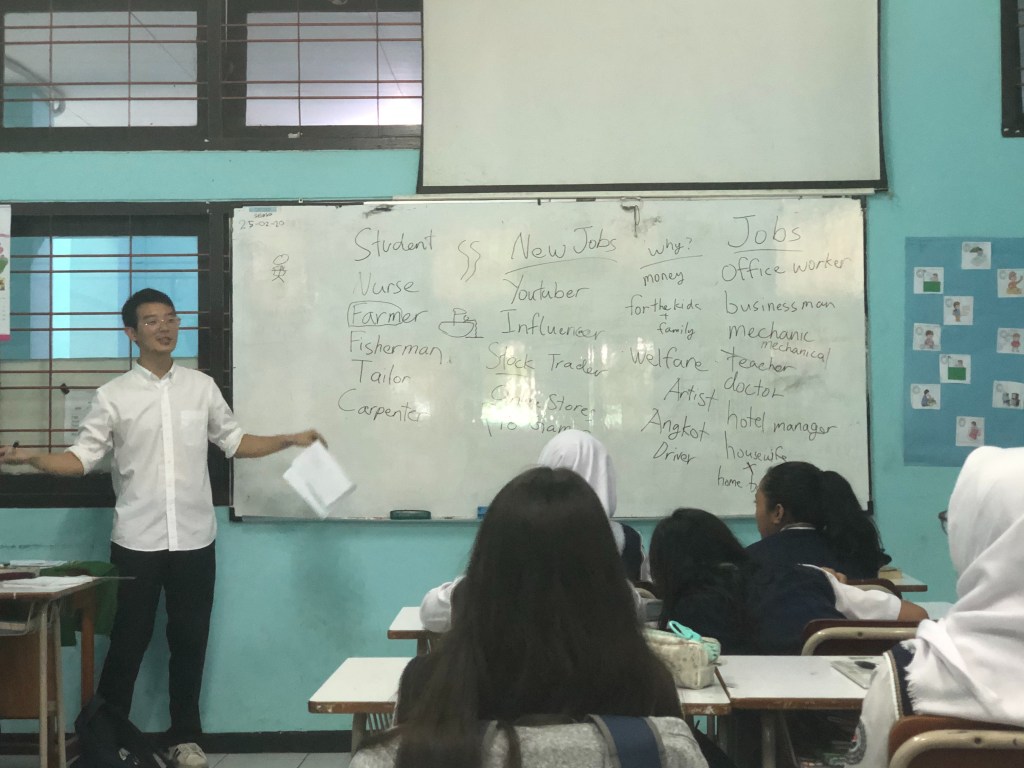
A happy teacher teaching about jobs. (Possibly)
This topic was much harder to teach than the other ones. Personality, Appearance, and Descriptive Text in General has a lot more content and possible topics to talk about. Jobs, on the other hand, is extremely bland in both the eyes of the student as well as the teachers. Most students know words for jobs; they know where these professions work and they know what they do. The issue, then, was on how to keep students engaged on the idea of jobs, as well as how to connect this with the other topics. Since Jobs, Personality, and Descriptive Text were all topics covered in Chapter 7 of the English textbook, I felt it vital to make sure these 3 were connected.
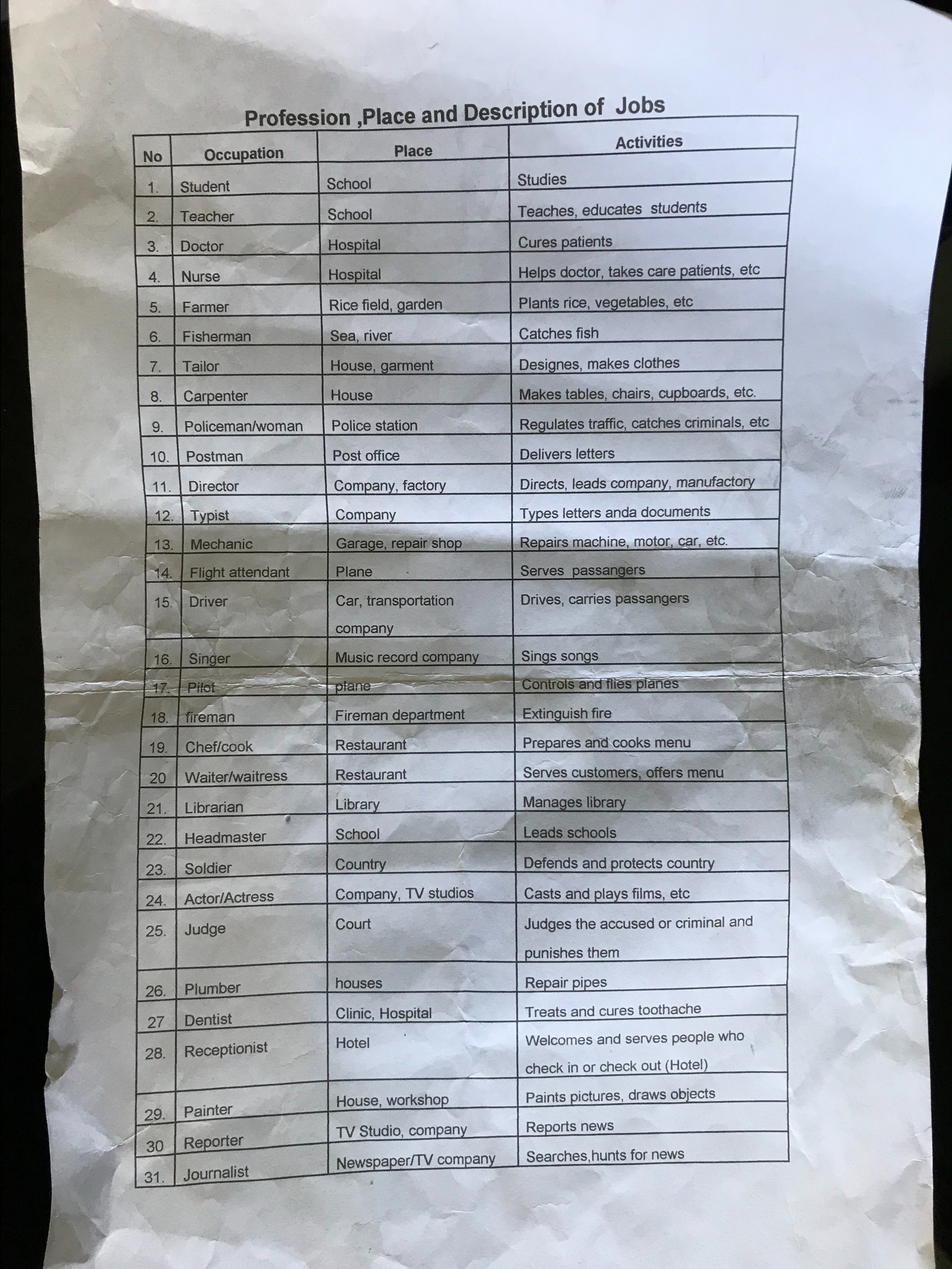
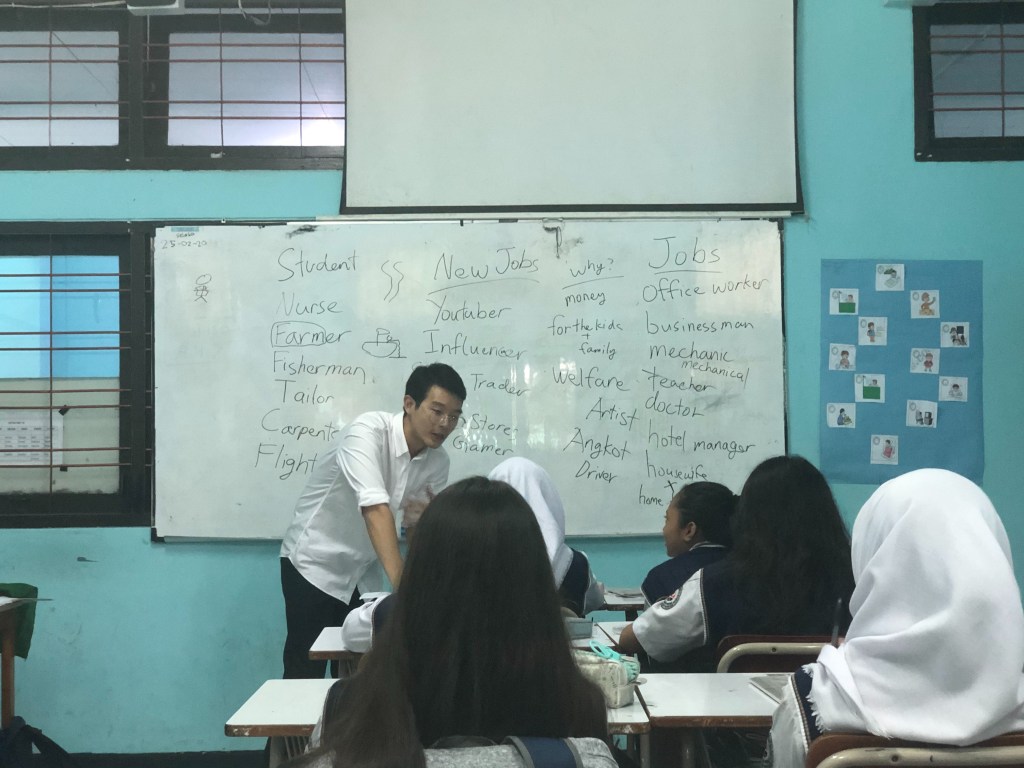
Procedures of Teaching Teaching Jobs was again split into two days. The first day was used to focus on a list of job names and information the students had to go over. It was imperative that students understood where a job is performed and the act of the job itself in order to connect it with an overarching theme that I wanted the students to understand. After going over the words, I asked students to provide additional words based on what their parents did (do make the topic more personal). All of these words were connected by how I presented them as “important to society and welfare”. I asked students many times what was the “significance” and “role in society” each job played, spending extra time on jobs like “bus driver” and “janitor”. These are infrastructure roles and should be respected, which is a message I tried to pass on to the students.
After, the students were asked to write a few sentences about what they want to do and the social significance of that job. This was to be used in the next class. Finally, a review of the words and the class was given. Since the list of words was large, it took the majority of this class.
However, those of you with a keen eye could see that I missed out on writing about the charades game. This is because this week had an unforseen free day, so each class could actually be taught the topic in only one day. I had to combine Day 1 and Day 2 in one 70 minute period in order to accommodate, which is why I removed the game. Because of that, the above lesson procedure actually continued after the writing:
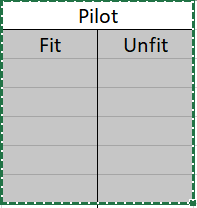
After the writing, students were introduced to the idea that jobs and personality were connected. Personality traits either fit a job, or did not fit a job. It was split like this:
Students were asked to write personality trait words on both the Fit side, for personality traits that fit, and Unfit side, for personality traits that were Unfit. I kept students engaged by randomly calling on students and asking them to give me a word from Fit or Unfit by yelling out “Fit!” or “Unfit!”. I specifically targeted bored looking students to give them a jolt to pay attention again.
With this exercise, I last asked students to finish up the writing assignment from before. Where they only started by writing the job they want and significance, they finished by writing about why they are a good fit for their jobs. With that, class was over and the writings were to be collected the next time.
Time Management and Organizational Activities. Time limits were set as per the teaching plan, but with the shortening of classes, the base time schedule was like this: 30 minutes introduction and lecture (word list), 10 minute writing, 20 minute lecture and group work (Jobs and Personality charts), 5 minute writing, 5 minute review. All times were adjusted based on each class’ needs but were mostly kept by a timer.
Organizational Activities were mostly that of finding ways to describe job words and their activities (by brainstorming and semi-charades), and the personality fit-unfit chart was a fast brainstorming exercise where all students were called on it a very short period of time forcing students to think fast. These were done multiple times to help struggling students learn how to think.
Classroom Management As always the biggest issue is keeping students engaged and attentive. I once again used the clapping activity to keep all the students on the same pace. I also made sure to address students directly whether it be them doing well (positive reinforcement) or if they are being disruptive or inattentive (negative feedback). I also started making students repeat words and phrases that are important, but by changing the tone, volume, and voice in order to make that fun and interactive. It seemed to work for the most part, but it can be certain if every student was participating.
Problem Solving with Teaching Issues with student understanding is inevitable since 6 different leveled classes had to have different approaches. The biggest issue is the understanding of instruction. In doing so, I not only slowed down speech, but also repeated sentences many times, as well as walking around as students were working in order to help them with what they don’t understand. Since this is language teaching, other forms may not be as effective since there is nothing better than simply being direct. I did not have other problems with teaching, but with the 6 times I have to teach each lesson, I could see how the teaching got refined as I found what worked and didn’t work. Perhaps practice is the best for problem solving while teaching.
Week 2 was from 2/24 to 2/28. During this time, I once again taught all the seventh grade classes pointers on descriptive text. However, this week’s focus is on jobs. In order to build the student’s knowledge base, I decided that combing descriptions of jobs with connections to personality would be the best approach as students had just finished a week on describing personality.
Curriculum This week is still part of Chapter 7 “Can you describe it to me?” of the Bahasa Inggris textbook. The main theme is descriptive text, but has gone from describing things, to people, and now to jobs. The main purpose to give students language ability to describe many common parts of life. However, Jobs are not explicitly given a large section in the book, and this lesson plan is based on a pre-made list of topics to cover created by the school and mentor teacher. I have adapted the base idea into the lesson plan you see above.
Teaching Plan Once again the teaching plan has been separated into two days. On the first day, students will review some commonly used English words to describe jobs. I am sure many students know basic jobs like Doctor or Teacher, but the idea is to let them practice speaking them more. For the more advanced students, I have also included what are “new age” jobs, careers that have come from the advancement of the internet. Jobs such as “Influencer” or “Youtuber” have been included. This allows students to think about how the current world is thinking about jobs.
Next, instead of focusing on simply speaking English words, I’ve created a charades game where students will start connecting imagery and visualization with the words that they will need to remember. Again, the creativity of students for their actions of “new age” jobs will be highly important as this will create a prototype for their job schemas. Although I am sure the students will be fine with most jobs, I will be monitoring the validity of their charades.
Finally, I will be making students think about the impact of jobs on society. For example, Postman is one of the jobs I have included, as well as Bus Driver. These two jobs, while understandably low in prestige, should be considered by students for their contributions to society. As homework, students are made to connect this notion of social value with their own dream jobs in a writing assignment.
Day 2 is when I connect personality and jobs. Students will start thinking about what personality traits fit the jobs discussed in the last class, as well as what personality traits definitely don’t match. In addition to how jobs benefit society, this allows them to think what kind of person makes a job viable. Since students have done homework about the jobs they want to do, I start making them consider how good a fit they are for that job. Although we still talk about describing jobs, my goal is to make them think about careers in a more critical manner. Finally, students are introduced to “Office Worker”, a generic term used to describe a non-specialized worker that many will find plain. This pushes students to think about their own goals and future, and whether or not becoming an office worker is a good fit, or if they have a goal to work towards in order to not be an office worker.
The week of 2/17-2/21 was the first official week of teaching Practicum. It was also the first time I was able to use the teaching plan I made myself. This week’s lesson was on describing people: personality, appearance and preference. The lesson plan can be found here.
Procedures of Teaching Classes are generally around 30 students, where the majority of issues lies with keeping students engaged for the entire 70 minute block. I first start with some conversational topics and jokes for the first 2 minutes as students settle in after break. Then, I take around 3 minutes to do a quick review of topics from the last class. Since this lesson has a day 1 and day 2, the second lesson is a review on what we covered on the first day as well as a talk about the homework.
Next, I head into the Introduction of the day’s lesson. Day 1 was an explanation of Appearance, Personality, and Preference followed by an exercise where students describe me. Day 2 is a longer introduction where I introduced new vocabulary and phrases for students to learn how to talk about themselves. The most important part of the introduction is to give students a chance to learn about the new topic as a class. I choose students to answer and try to give them all a chance to make sure they are all engaged.
After, I create a development period for the students to consider these skills on their own. This either comes from group work or individual work. Group work is based on writing down their thoughts and answers to a task I give, then sharing answers as a group to the class. Individual work is grammatical writing, where they try to answer in paragraph form a task that I present. Either way, this allows them to practice the topic I just covered with the class.
I then do a short review of what was just covered. If there is time, I invite some students to present their individual works. If it was group work, I try to lengthen the time by asking additional questions where possible. Last, I give an overall recap of the things we covered in class and assign them an easy homework assignment due by next class.
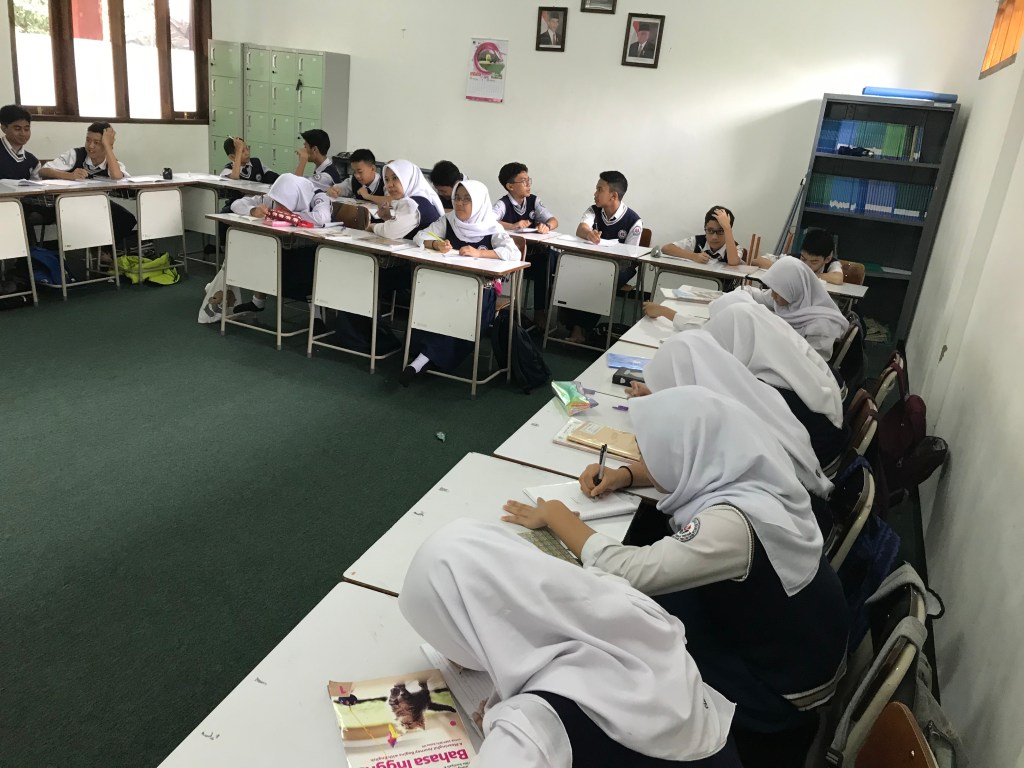
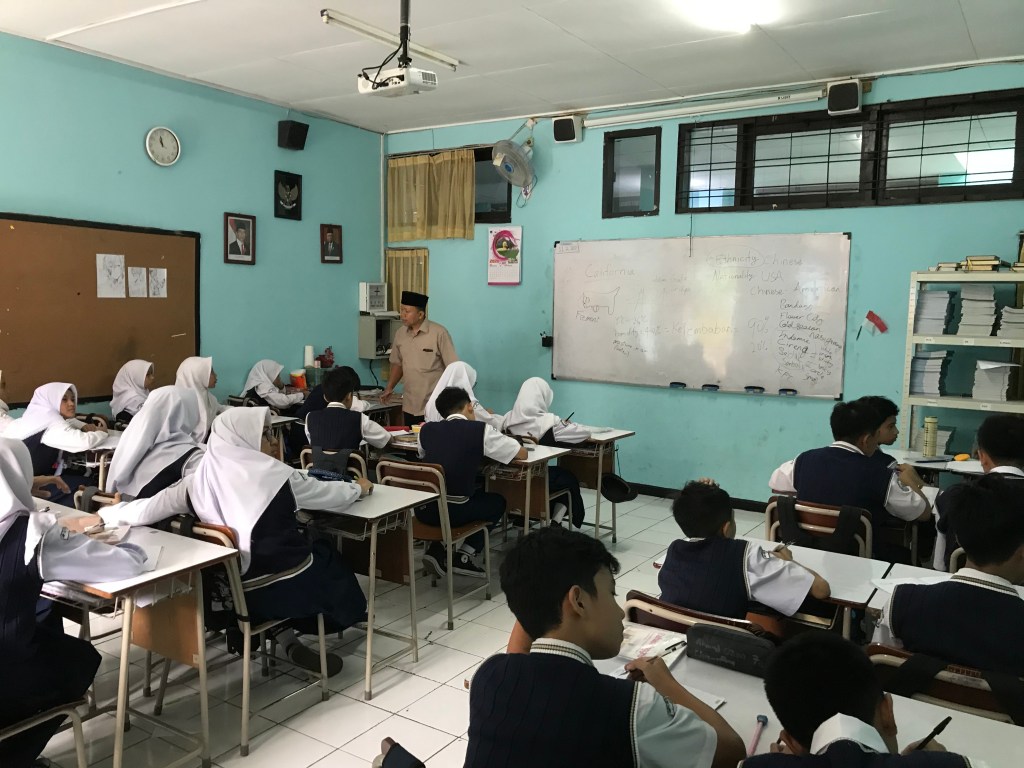
Students during the lesson.
Time Management and Organizing Activities One of the greatest issues with teaching is the time limit on every class. Although 70 minutes may sound like a lot, it rarely is enough. Time management for me is based on what I have already dictated on the lesson plan: usually a 25-minute introduction, 30-minute development task, 5-minute review, 5-minute explanation of homework, and 5-minute cool-down period.
This time breakdown is kept on a timer on my smartphone to make sure I’m on track. Although classes don’t usually follow such a strict timeline, I can be flexible with development task or introduction time in order to ensure understanding of any material covered. The most important part of organization is not allocate strict time, but to help understanding in that time. If one student does not understand a part of the introduction, they will slow down all in development.
In this week, I developed a simple but effective clapping game to keep all students attended on me. I would clap twice and follow it with them students clapping back twice. The number of claps would change and they would do so too. This becomes a short-term fun game that lasts no more than 10 seconds.
As this teaching plan has a lot of exercises, I try to make time for each. However, in the event each cannot happen, I focus on writing and group based tasks. What I deem to be more beneficial to students (such as the writing task about family members) is what I give more time to.
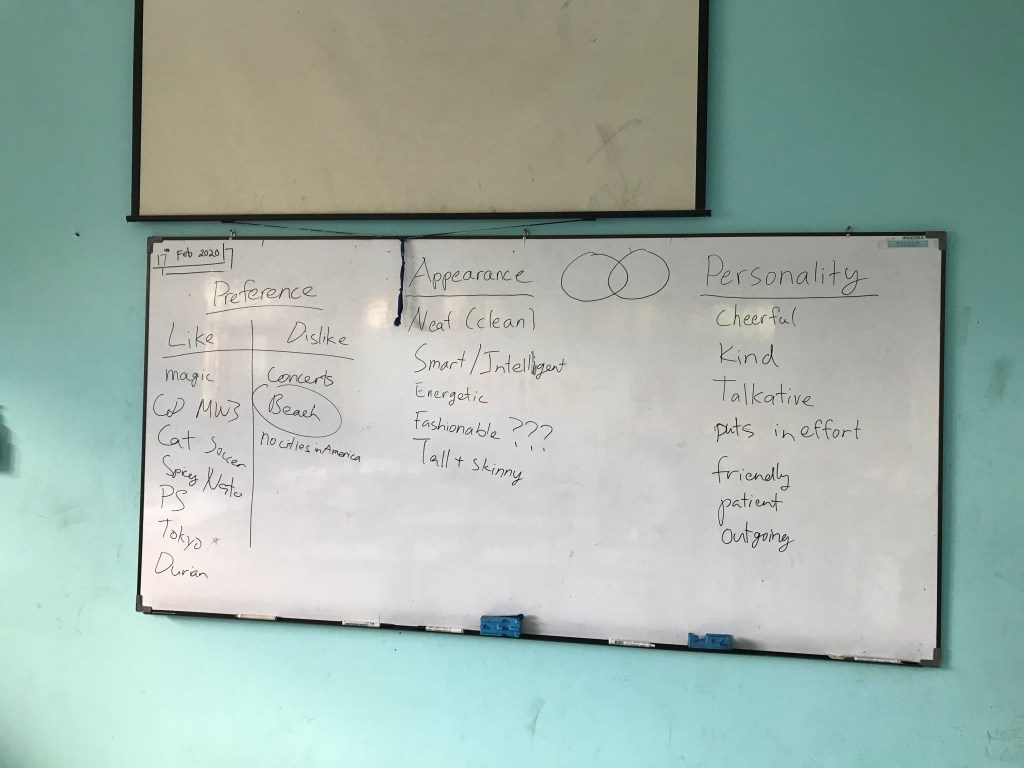
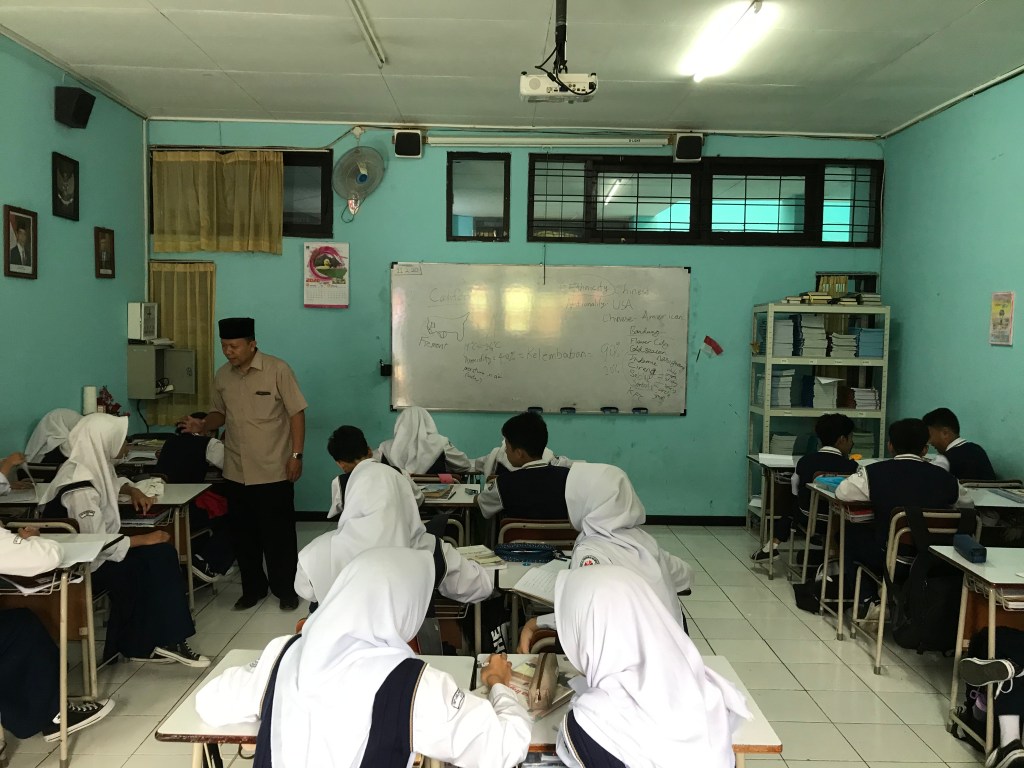
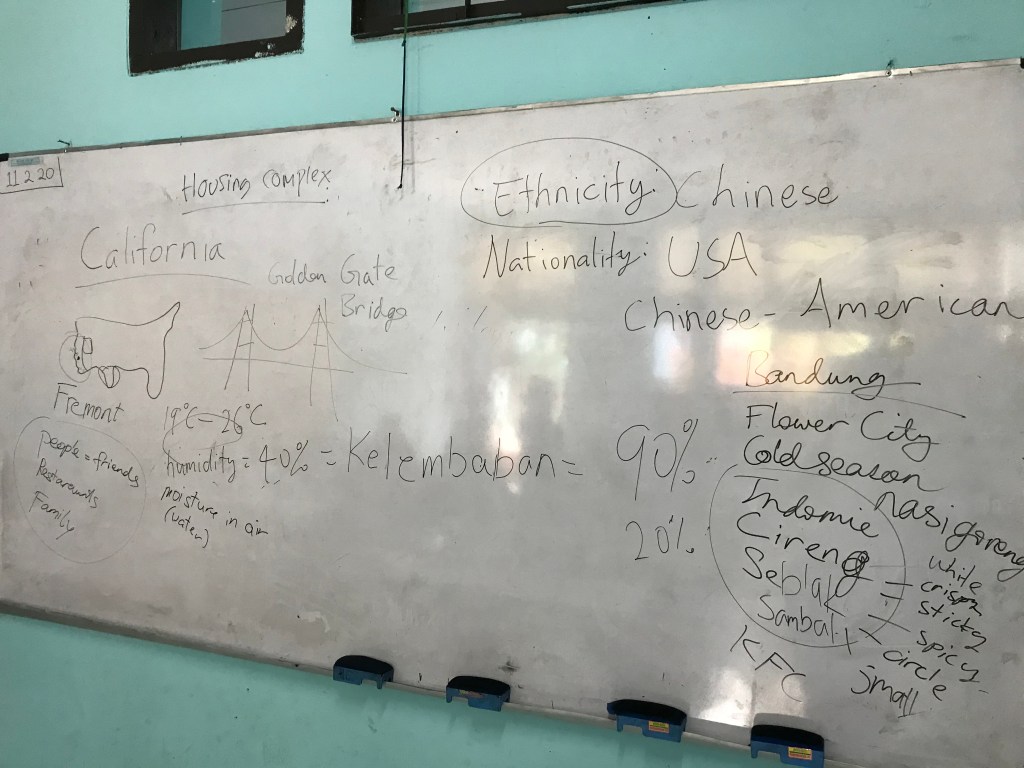
Whiteboard from Day 2
Classroom Management Students already have their seats, so I did not have to worry about seating charts or names. However, as these are junior high students, they are prone to talking among themselves and not paying attention. In order to combat this, I use the clapping mechanism mentioned above. For introduction lessons, I also make students repeat key phrases and vocabulary under the guise of a pronunciation check, but it also doubles as a way to see which students are looking up and paying attention rather than looking down.
In situations where students have a good reason not to listen (such as illness), I make sure to treat it as an individual case. For example, one female student had a stomach ache while in class and could not participate in lectures. I made sure to approach her, find out what’s wrong, provide comfort, and allow her time to rest. I believe that trust is what’s important to make the other students believe they can pay attention genuinely.
Problem Solving While Teaching As with any ESL, the biggest issue is when students do not understand what you are saying in English, but can communicate in their mother tongue. Thus, students help students, but they don’t necessarily learn English this way. I realized this issue after teaching a few classes, and this behavior continues. However, to combat this I decided to choose students directly in an energetic manner rather than just point at whomever. I do this to show an enthusiasm and expectation that they can answer. Most of the time, they do try. During times they cannot answer, I either move on, or ask the class for their input on this question in order to help that student.
Other problems arise when tasks and instruction are not understood. I have slowly tweaked the lesson over the multiple times I teach it in order for my word choice to be simpler, clearer, and easier to understand. I start to talk slower and repeat myself more. Although some students feel annoyed, because all students in the class are not of the same level, the performance overall has greatly improved.
I give plenty of positive reinforcement to students since many have not studied English extensively, before. However, when they do not pay attention or are being disruptive in class, I do not hesitate to discipline. I make sure to connect with students based on hobbies and interests outside of class, so the discipline can be felt coming from an authoritative rather than an authoritarian perspective. Gaining the trust of students was crucial for being able to control them in the classroom.
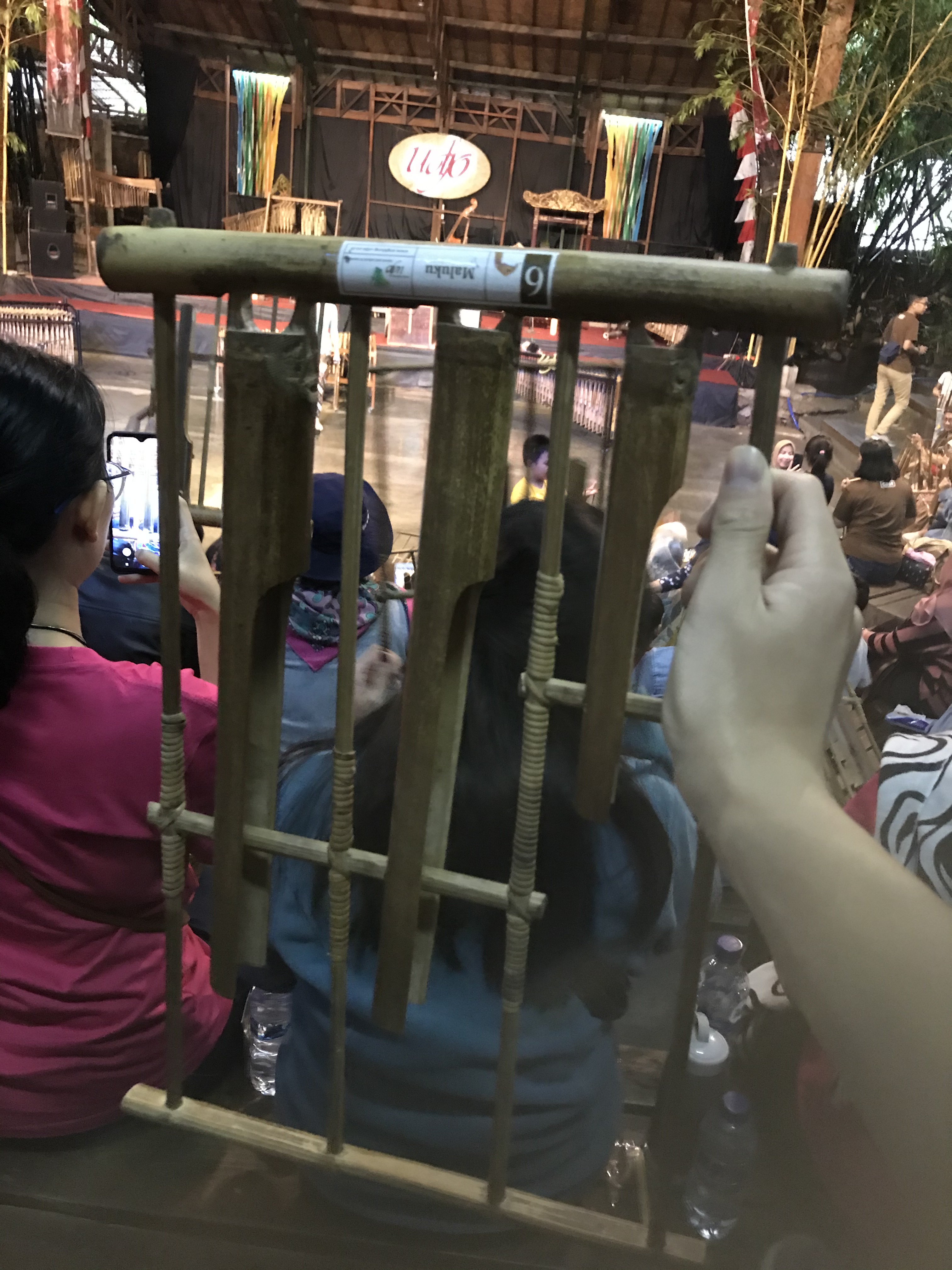
February 15th was a Saturday Excursion day planned by the university. Three Indonesian University students (the “Buddies”) accompanied all the student teachers to Saung Angklung Ujo, a premiere school of traditional Indonesian art. There, we all watched a presentation of Angklung music which lasted about 2 hours.
The Angklung. Indonesian musical instrument.
Although the Angklung sounded like wind chimes, the diatonic scale they made the modern Angklung into allowed it to play contemporary music. That ability was experienced by all the audience in a form of basic Angklung orchestra. However, I do think the Angklung isn’t a very practical instrument as the size makes it too clunky to carry around.
Surabi, aka better Eggs Benedict
The group ended the day at a local Surabi restaurant for dinner. Mine had chicken, eggs, sausage, and the yellow mayo that it was drenched in. The sticky pancake base made this pasty more like a meal, and I enjoyed it more than I expected.
The day ended at around 9pm, and Surabi made it a great ending for a free day with friends.
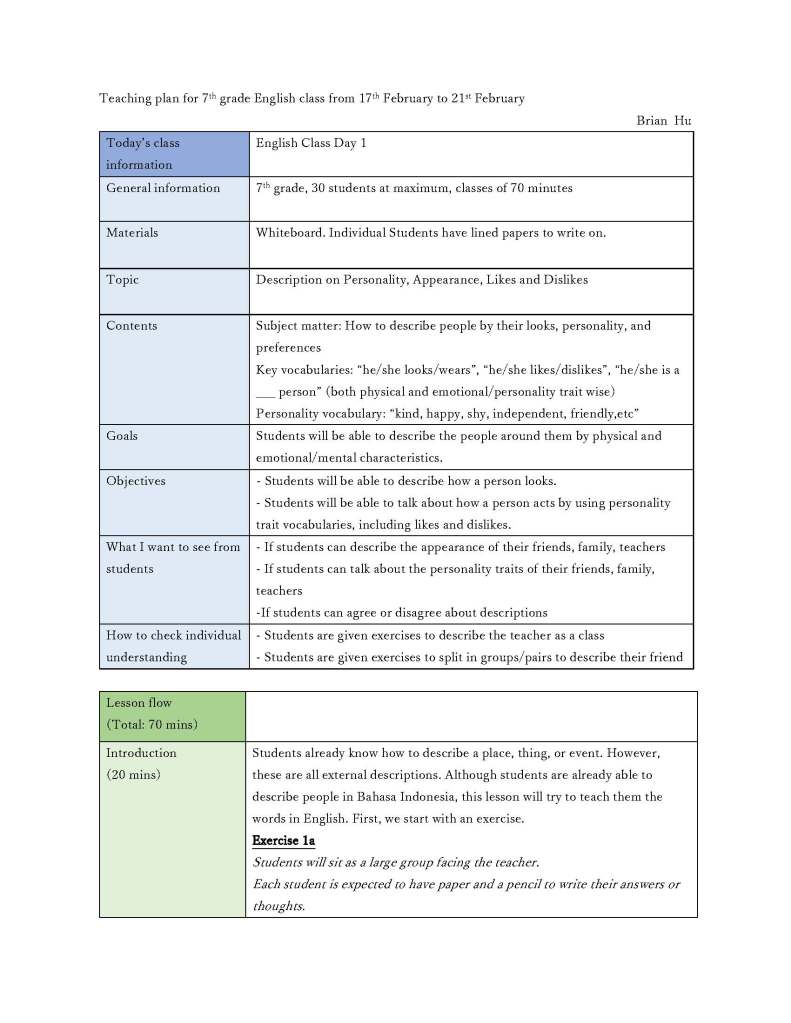
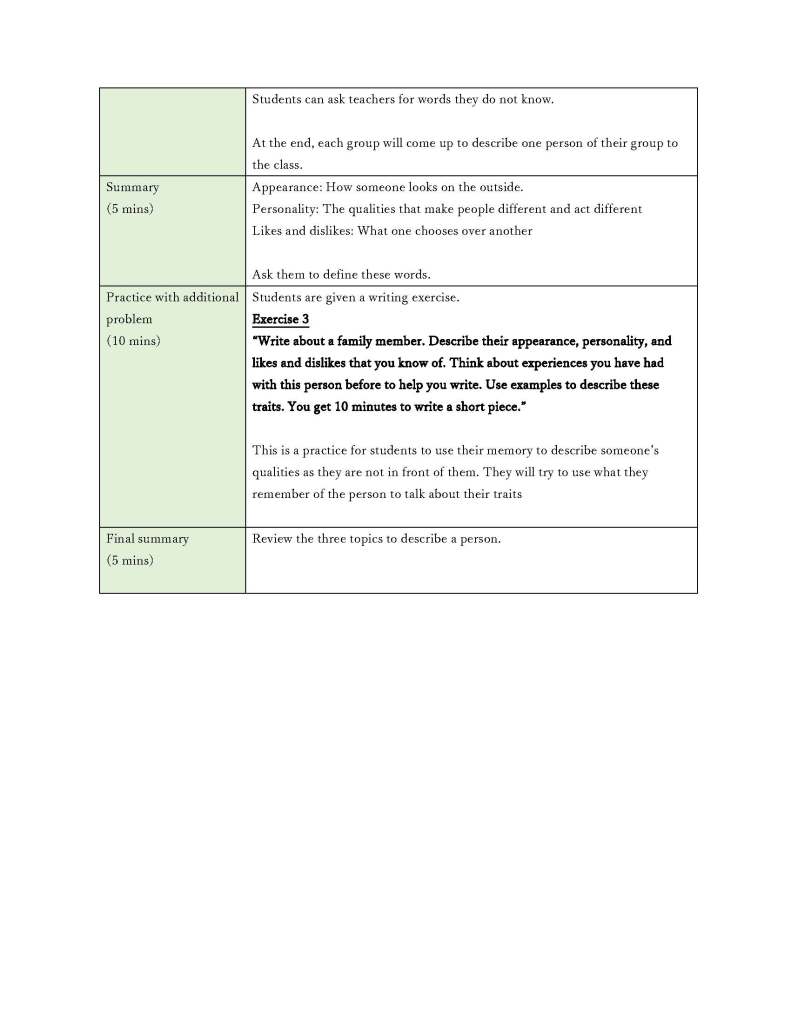
Teaching Plan 1 Day 1 and 2: Appearance, Personality, Likes and Dislikes Unit
Current Curriculum The English Curriculum for the month of February is of descriptive text starting from describing external objects such as places or things, to in depth descriptions of people. Teaching Plan #1 is for the first week of describing people through their looks, personality traits, and preferences.
Teaching Plan Day 1 On the first week of Teaching Practicum, 2/17-2/21, I was assigned to create a lesson plan for the unit that was to be taught to the students. Compared to the last week of introductory lessons I taught, this week can be a continuation of the skills from last week which was “Descriptive Text”. Students were to move on from only describing places, things, and events, to being able to describe people. However, most students are able to describe physical aspects of others: height, clothing, looks, etc. This lesson plan tries to introduce students to describing people by their INTERNAL CHARACTERISTICS.
For example, students will be able to not only describe that a person “looks kind”, but that a person “is kind”; a student may describe a peer as shy but smart. Of course, since English is not the student’s first language, it would not be surprising to know that the student’s repertoire of vocabulary is not wide. That is another goal of the lesson: to expand the descriptive vocabulary of the students.
This lesson plan uses 3 separate exercises to build upon the overarching goal of using English in descriptive format. First, a whole-class activity that focuses on fun and motivation is given to the students: Describe your teacher. Through physical descriptions, memory of experience for inner traits, as well as asking questions to learn preference, students gain a script that they can use in Exercise 2.
Exercise 2 is group work where students describe peers. They will be using the vocabulary they either just gained from Exercise 1, or will hopefully be motivated enough by the fun whole group activity to ask the teacher. Later, they will present to the class what they talked about in order to train student’s speech ability.
Last, Exercise 3 is an individual writing task that focuses on remembering events with a certain family member. That will allow students to be analytical in their writing about the descriptions as well as gain a deeper appreciation for introspection on the people around them.
All evaluation will not be only based on grammar and vocabulary, but the integration of description of other people’s appearance, personality, and preferences into generalized usable English.
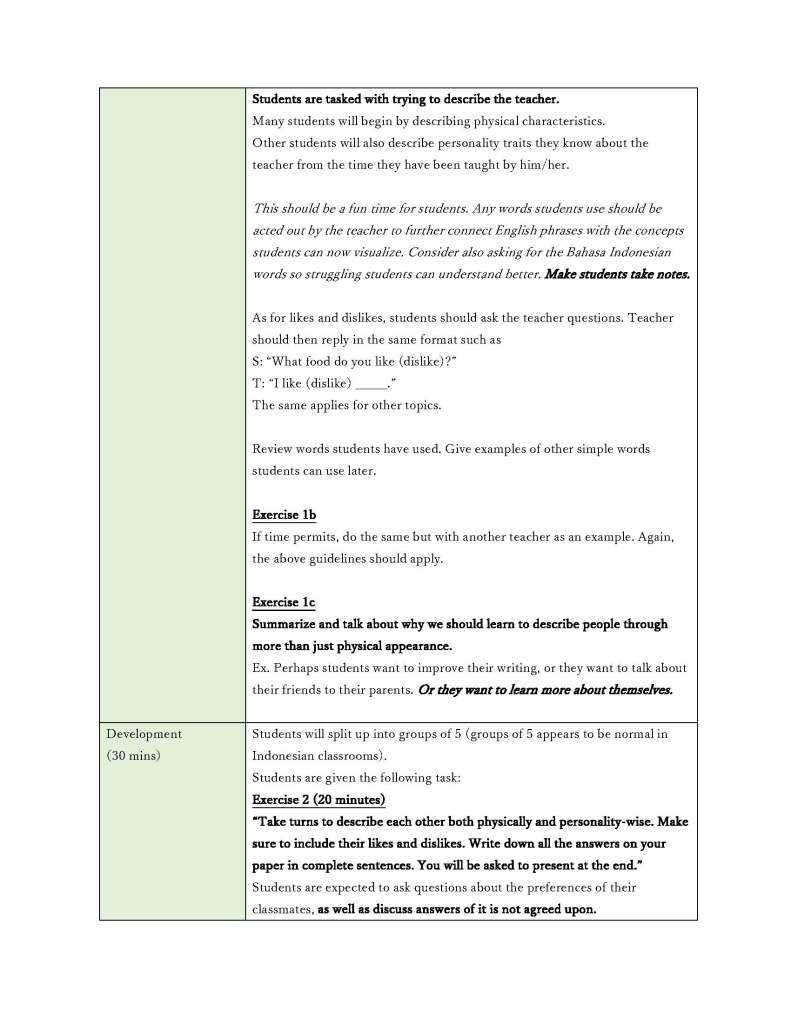
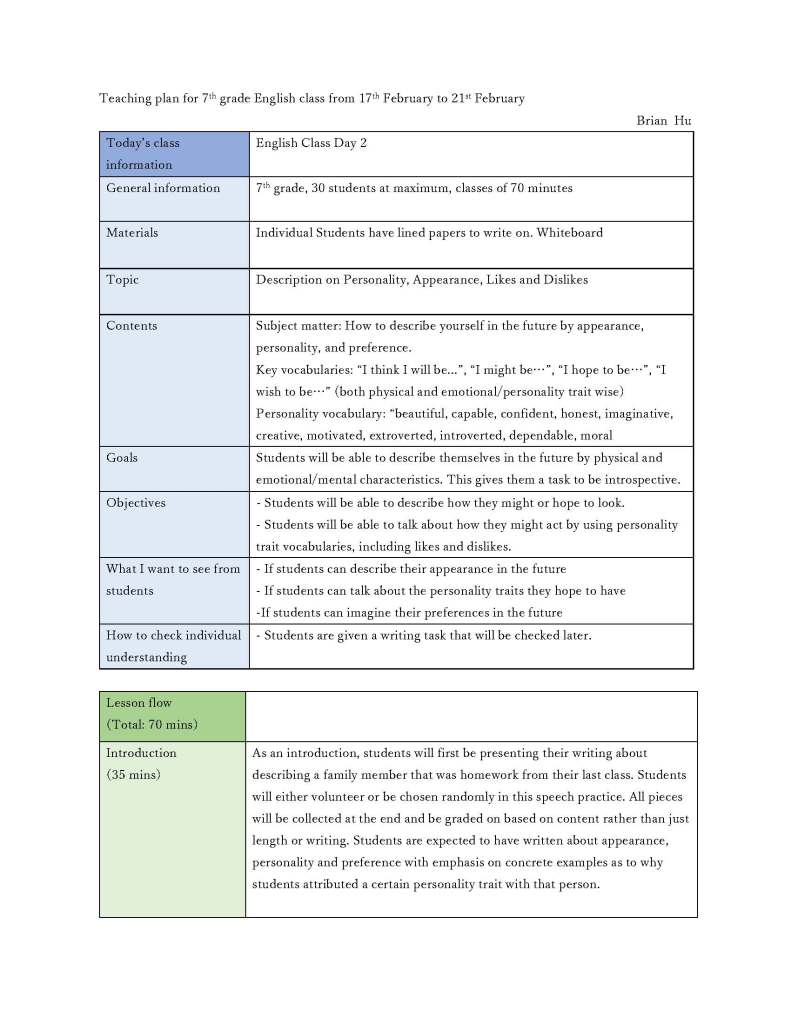
Day 2 This second lesson plan is needed because each unit is taught for one week, but individual classes have two separate English classes. Thus, a second lesson plan on the same subject is required for the additional 70 minutes. This one continues to develop the student’s ability to describe people
First, this second lesson plan picks up where the other left off in student’s ability to use appearance, personality, and preference as key points. However, unlike the last lesson plan where the target is someone else, this plan focuses on students being able to introspect and describe themselves. In my mind, the purpose of describing others is the ability to gain the language necessary to understand the self more. Thus, after an introduction of homework presentation, the lesson starts by introducing new words.
Along with new words to describe personality, students are then taught how to talk about describing people in the future, namely themselves. These are the key phrases students will be using in the in-class exercise. For 25 minutes, students will be writing about how they see themselves in the future. This not only requires them to think about themselves now, but also what their goals and dreams are. This exercise thus practices their ability to describe another (since future self is not present self) but also to think about the morals of what they wish to become.
Last, a homework assignment is given where students will use their own expectations of future self and compare that to ones that their parents have. This will allow students to see the changes of the times, how people view happiness and success, and allow them to have a new perspective of their own future goals and wants.
Day 2 of Observations was another hectic day of interacting with students. My mentor Mr. Kurniawan, appearing in picture 2 at the front, continued with my introduction to all the 7th grade classes. Although this was initially meant to be an observation week, I was allowed to have the task of giving a short lesson by myself, again. In fact, I was allowed to hold this impromptu lesson for each class in the day.
The English Class Mr. Kurniawan taught is currently on the chapter of Descriptive Texts, or how to use English to describe a person, place, or thing. For that, an introduction about myself became the perfect example to use. Students were interested in my background as a Chinese-American, as well as an international student. The general Lesson Flow is as follows:
Introduce myself by having students think about the difference between Nationality and Ethnicity.
Briefly describe my experience living in California, while engaging students in conversation about what their preceding ideas of the US are.
Ask them to tell me about what they know about Bandung under the guise of me wanting to know what to do while I’m here. The conversation can go in any direction, but generally can be guided into topics such as food and locations. When a student says something the others also agree with, it becomes a TEACHING OPPORTUNITY where I ask many questions to try to make the students use descriptive language about that topic. Focuses include visual aspect, taste, smells, and personal preferences.
Ask students to WRITE a short composition about where they live where they describe their neighborhood, house, or housing complex. This will be presented either at the end of class or in the next class.
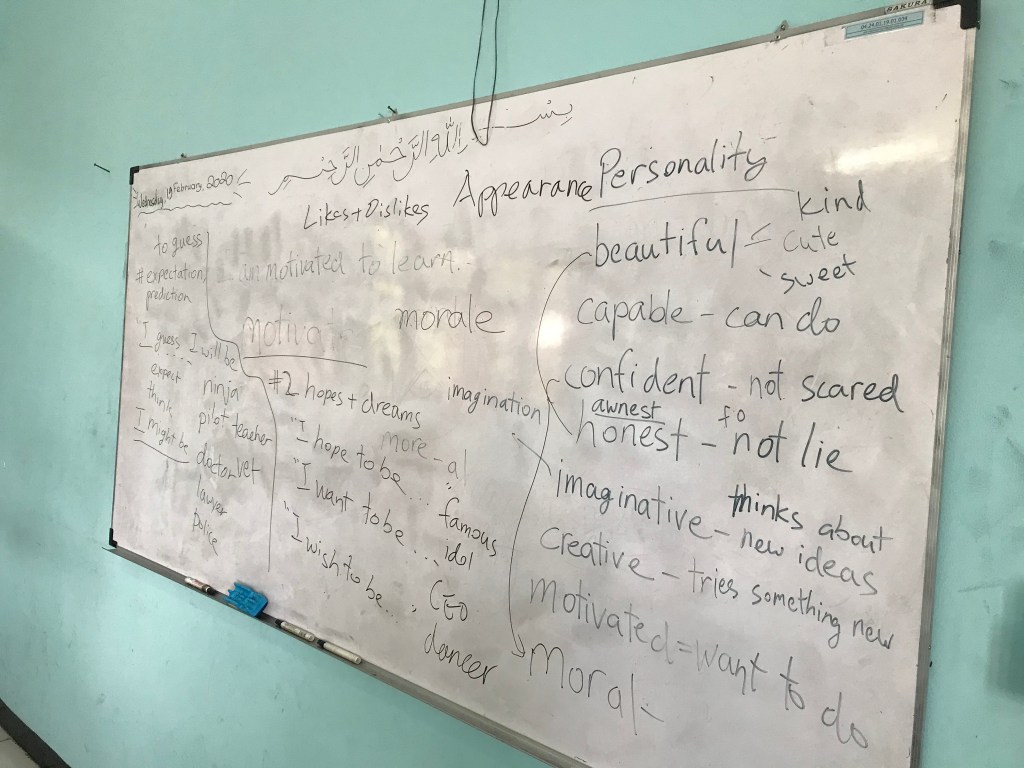
Whiteboard usage was generally frantic as I strove to write down student’s thinking as a way to motivate their wish to speak in English.
A rather messy white board usage.
As this is still an introductory lesson, no lesson plans were made ahead of time. However, over the reiteration of the same lesson flow over multiple classes, I was able to refine the directives and entertainment value for the students. The students also seemed to enjoy the class a lot.
Day 1 of Teaching was just as hectic as I’d expect the rest of the experience to be, yet it was a considerably shorter day. In fact, it was just 30 minutes!
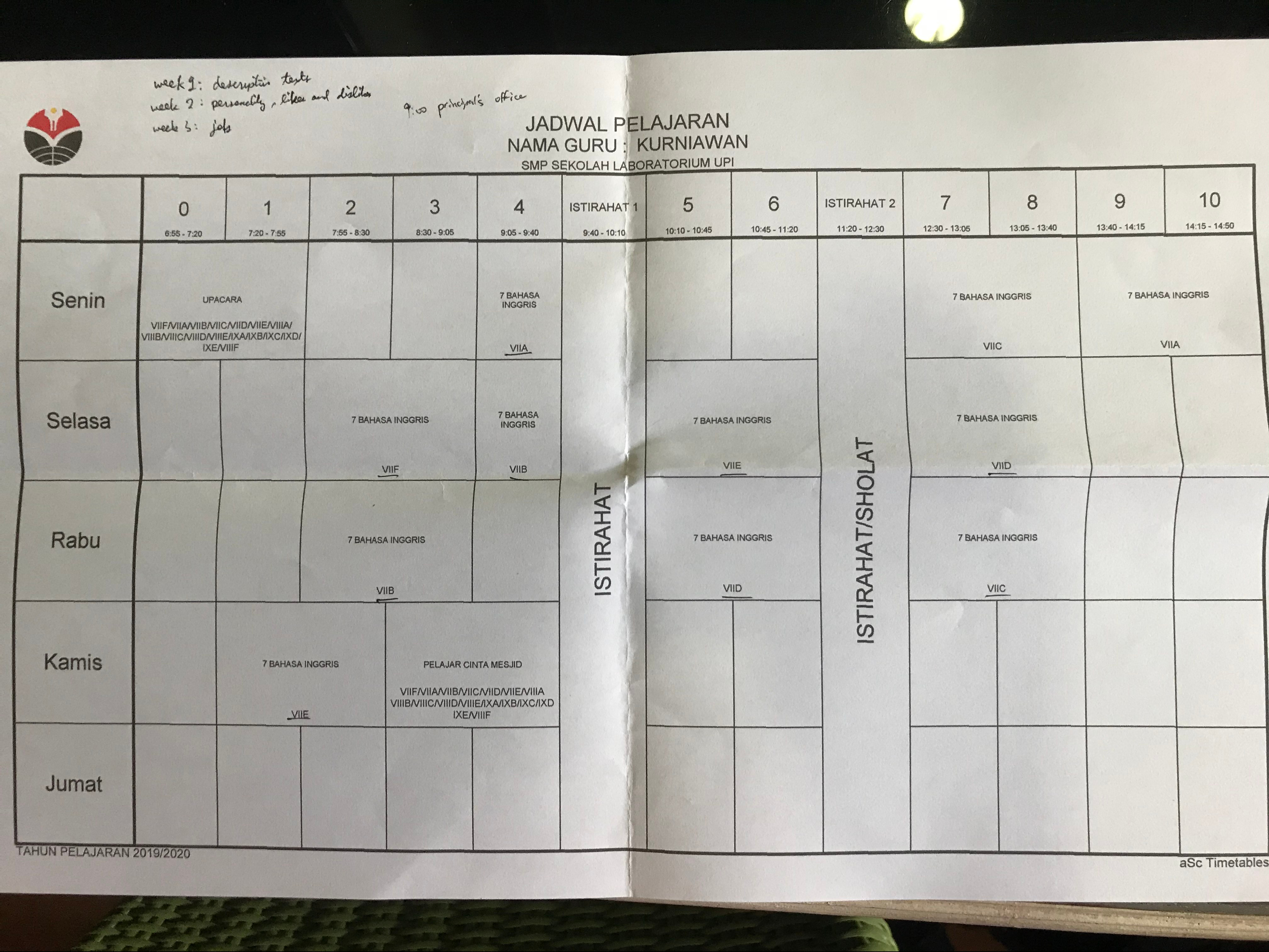
I’ll be teaching all English classes labeled Bahasa Inggris. It may seem like a lot, but the blocks are short.
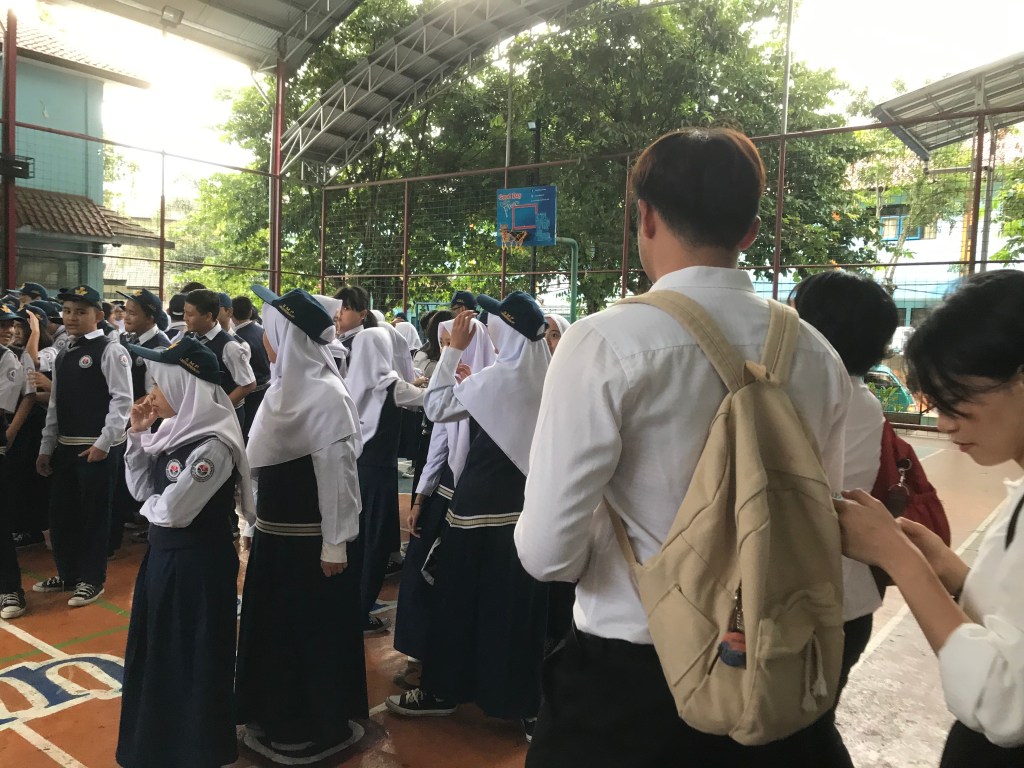
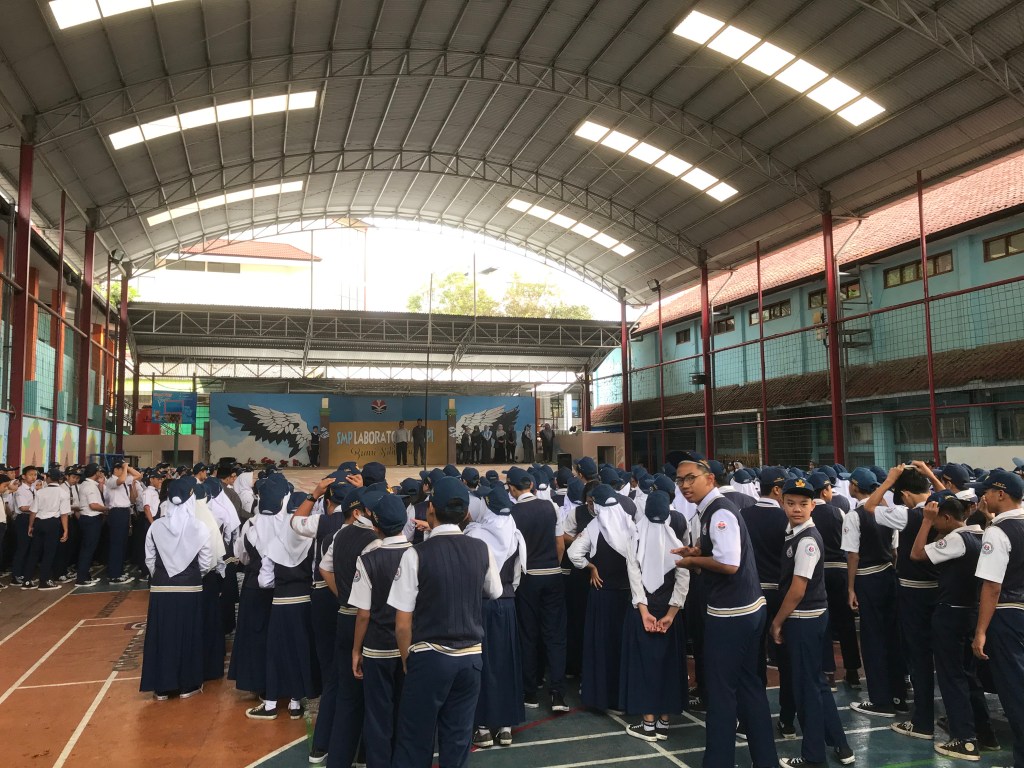
Senin is Monday, and the image above shows that there are three English classes taught by my mentor teacher, and what is called an Upacara or flag ceremony. That started at 6:55 AM, something that the western world would quickly call “TOO EARLY”. This being Indonesia, an Islamic country, the people would wake up to pray at around 4AM which also marks the beginning of their day. Although they wake up early, there was no shortage of energy.
Middle school students in uniform at the Flag Ceremony. Notice that all are wearing Converse shoes, a staple of their Uniforms.
The Ceremony took about 30 minutes, in which songs and speeches were said from the staff as well as the students. There were also many salutes and stands of attention, giving it a militaristic feel. I’m sure that it’s a symbol of nationalism in Indonesia, which is reminiscent of the Pledge of Allegiance done in the States. However, I’m not sure.
Upon finishing the ceremony, we (Pook, Be, Mirei, and I whom are the teachers for the middle school) were brought around to meet the staff, teachers, and Principal. With a short briefing of what was to come in our 3 weeks, the other three (who are to be math teachers) were disbanded for the day. I was allowed to give a short lesson to my first class of 7th graders. Of course, I took that opportunity to speak to as many of the students as I could.
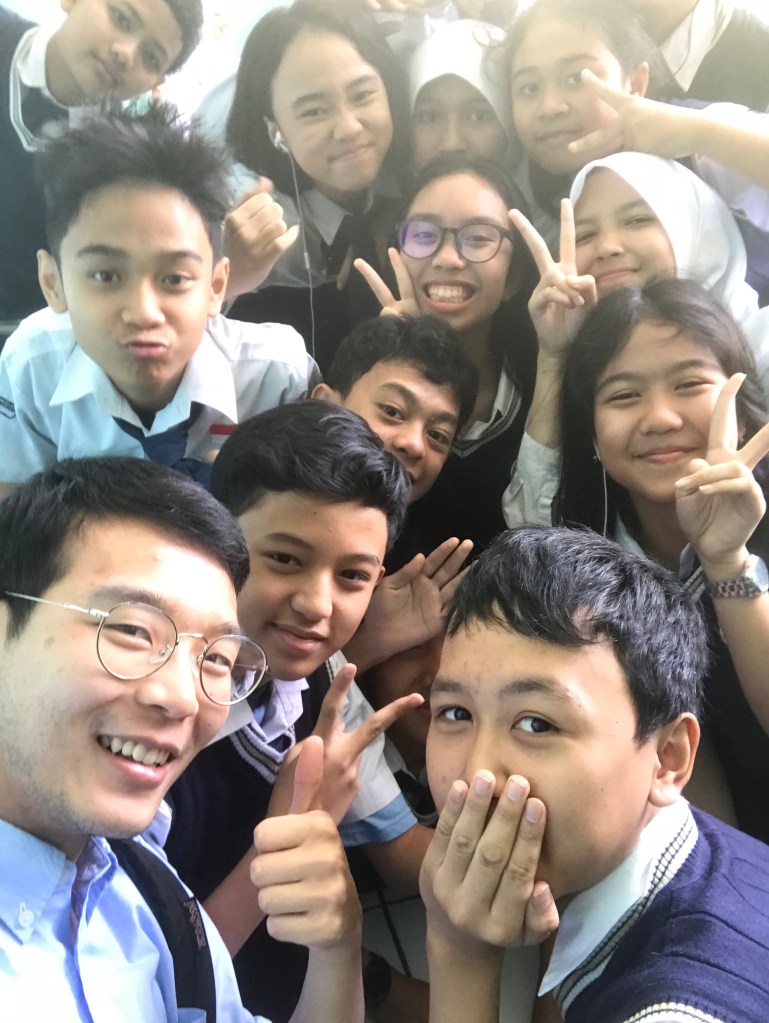
Me with a bunch of 7th graders! They crowded around to get in the selfie. Never have I met such friendly kids.
I took part in a small lesson focusing on the use of Descriptive text, but mainly took the time to present about myself and how I grew up. My mentor used that as a way to show the children why one shouldn’t be afraid to speak in English and/or to go abroad. I respect his philosophy as a teacher and truly look forward to working more with him.
The Children were active, were loud, and truly participated. I asked many direct questions to keep the class motivated, especially by sometimes making a fool of myself to keep them entertained (I couldn’t draw a bear so I drew a blow with four lines as legs). I was happy to see that these students not only could use English fluently, but were eager to speak with me. They didn’t shy away when I asked them questions, not even if I singled one out. This gives me hope for the coming weeks.
Yesterday was hectic enough that I couldn’t write a post. Or rather, I was so tired by the end that I didn’t want to write a post. The heat and humidity sure didn’t help, but it was an exciting second day that I spent with the Indonesian Students. It was also the day of the Welcoming Ceremony where I met both my supervisor and mentor teacher.
Oddly enough, neither of them were briefed with the information that I am not, in fact, Japanese. Their reaction was mixed, so I’m not quite sure what that means. What I do know is that, being a native English speaker, my qualifications will make it rather easier to teach English compared to my colleagues who will be teaching math. I do wonder how confused the students will get though; they did say they would introduce me as a Japanese student.
However, on this first free day I had the good graces of adventuring out into Bandung without the help of the “buddies”. Mirei accompanied me as we set off to the Electronics Center for some supplies as well as a much needed meal. We bonded over our mutual love for good food, as well as bough back plenty of fruit to enjoy later on that night. I haven’t had mangosteen in many years, and today was a reminder as to why I remembered that name.
I also had the chance to visit the university gym, where I had a conversation with a student entirely over Google Translate. I also attended a prayer session at mosque, something I’ve been meaning to do.
Right now, I’m just waiting for Monday to start work. Otherwise, I’m content.



 Brian's Indonesia SEAMEO