The first week of attending classes (2/10-2/13) were a mixture of observation and my own introductory experimental teaching. Mr. Kurniawan, my mentor teacher, is the primary 7th Grade English Teacher as well as the Vice Principal of the Junior High Lab School. Under his guidance, I was able to see how teachers in Indonesia interact with their students.
One of the most important pieces of information I got about the philosophy of Indonesian Teacher-Student relationships is of relational distance, of which there is little. Mr. Kurniawan specifically explained to me on the first day that the teacher-student relationship is more of a mentor-student relationship. That means the students don’t just look at the teachers as a more knowledgeable other in terms of academia (MKO of sociocultural theory), but also as the mentors for life. This is expressed by how students will ACTUALLY come to their teacher when in need of advice, or simply to use them as a counseling role. Compared to the USA, this mentor-student relationship is much more prevalent. Although all teachers wish to become a mentor, Indonesian culture allows this kind of philosophy to bloom.
Teaching Methods
On 2/13, Ms. Mirei and I observed an 8th grade English class taught by Mrs. Lina S. On top of my observations of the 7th grade English class by Mr. Kurniawan, it was a necessary and productive experience for understanding Indonesian teaching methods.
First, Mrs. Lina’s approach to communicative English for that class was focused on presentation. However, unlike the normal talk presentations usually assigned by US classes, Indonesian schools are allowed to extensive use of interactive lessons: in this case short acts of classic Indonesian folk tales. This is a great way to both reinforce practical English language and remind students of their ethnic heritage.
Everyday classes are taught in a classroom setting with students sitting in desks all facing the front board, or in groups where students then must turn their heads to face the board. Desks are rearranged according to the needs of the lesson. Group sitting is for the needs of discussions, while individual seating furthers individual thought.
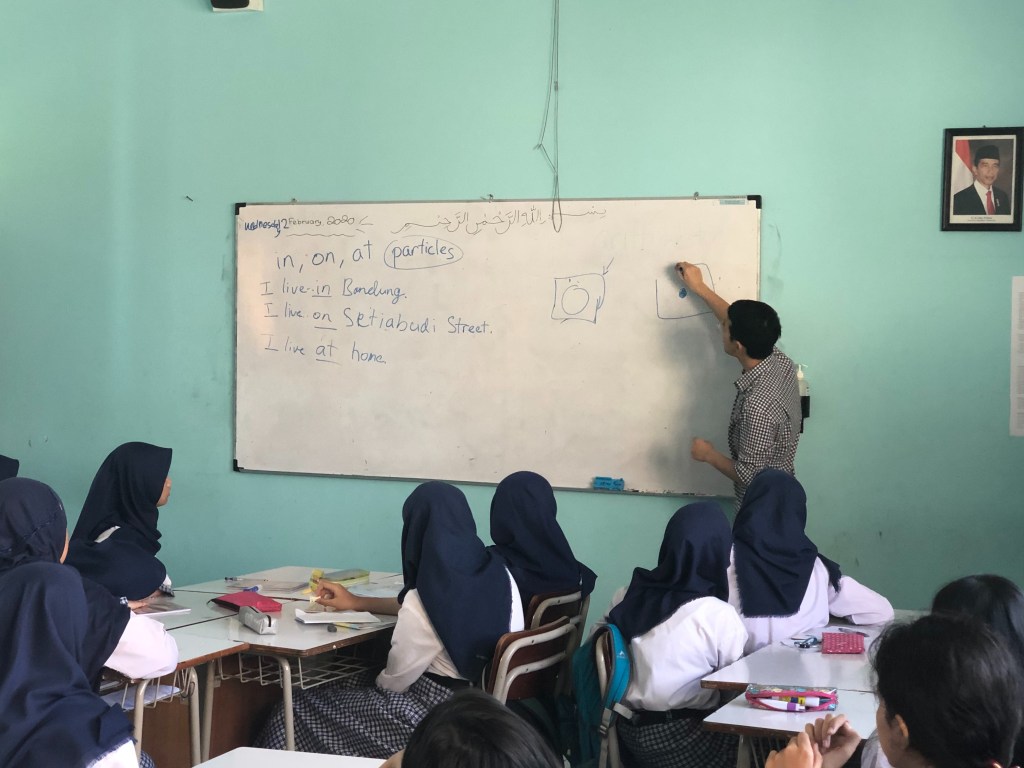
Lessons (as of that by Mr. Kurniawan) follow the curriculum of the school textbook and the guidelines set by the Indonesian government. Because of the close relationship of teachers and students, questions as well as comments are free flowing allowing for an active class time. Periods at this school are split into 35 or 70 minute sessions depending on subject. English generally has 70 minutes of instructional time. Teachers use a mixture of lectures, talking assignments (including dialogues with instructors and classmates), individual writing exercises, and short presentations to make students practice. At the end, summarization is used to recap the lesson to make the students understand, although this may be used multiple times because one lesson may hold more than one topic. However, not all teachers use this sort of process, including the use of summarization.
Materials, Innovations, Technologies
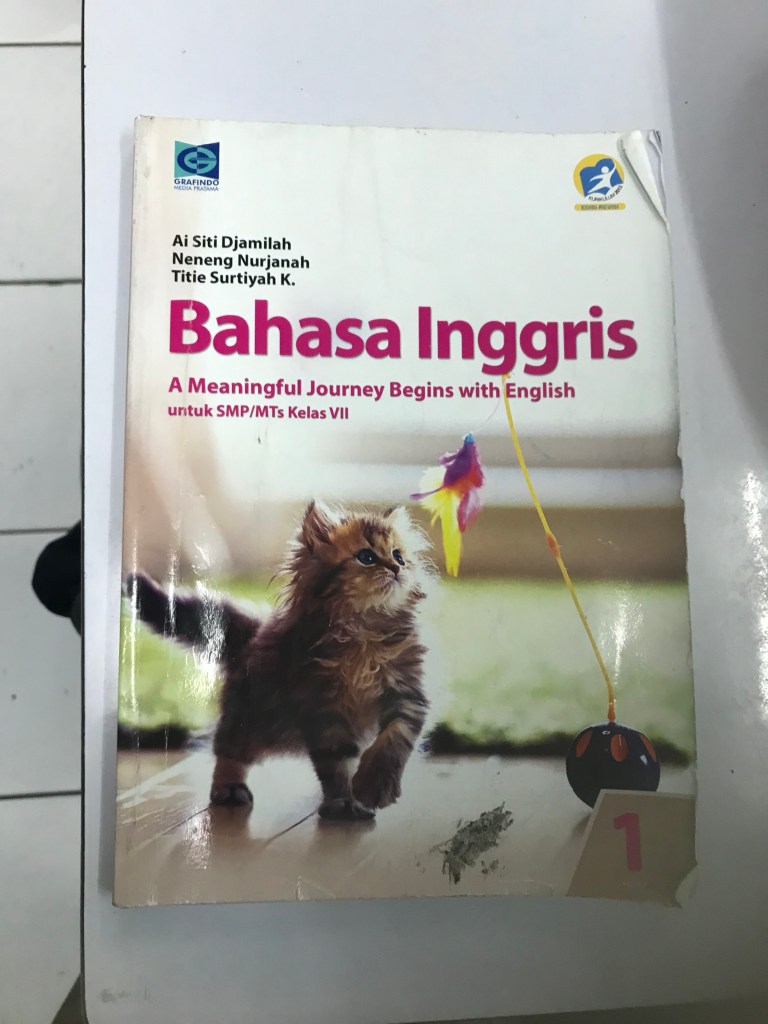
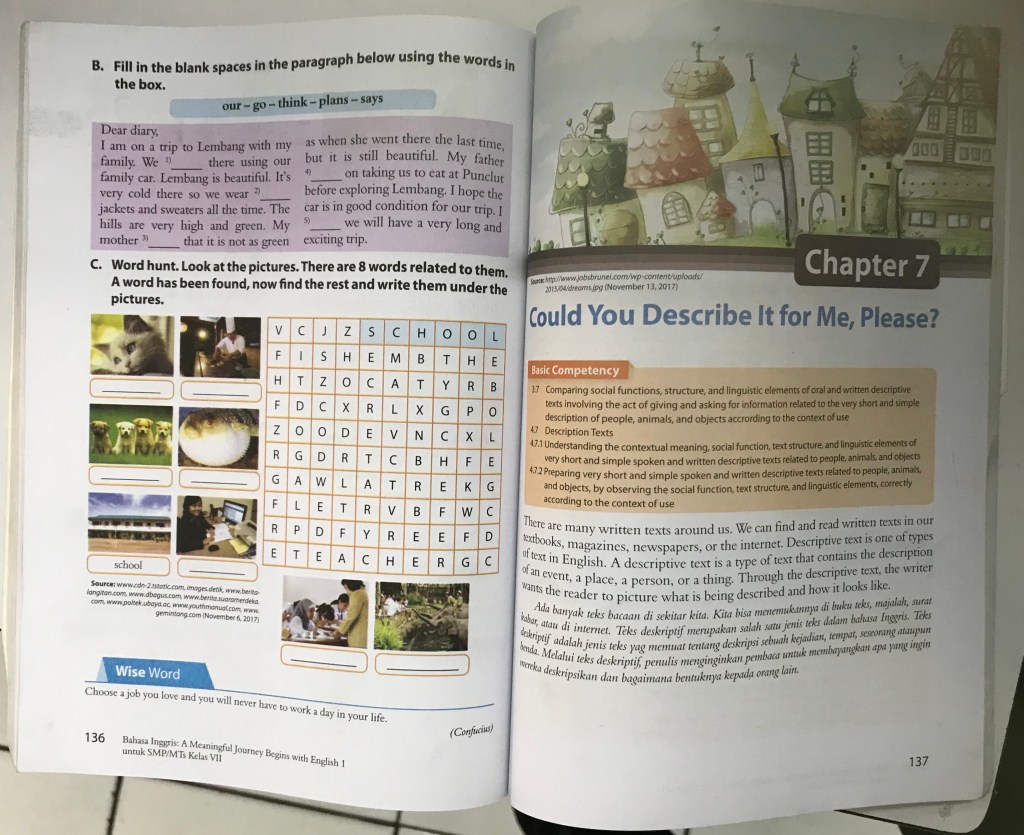
The common textbook used in the Middle School Lab School is the above “Bahasa Inggris”. The book is divided into multiple chapters, each detailing one common form of dialogue in English. My lesson plans were all based on Chapter 7 “Could you describe it to me?” in 3 parts. This textbook, however, is not the government issued one. A separate government issued textbook can also be used by schools, but the choice for curriculum is ultimately up to the individual institution.
To my knowledge, no innovative materials have been used. Standard tools such as a whiteboard, projector, laptop, and speakers have been implemented. A computer room is present with Windows 10 capable desktops, a library is available for student use, and a counseling room is equipped to further support students that are having difficulty.
However, what I believe to be innovative teaching methods are in place at this Lab School. On 2/14, I observed the Japanese class which is a very rare subject to be taught in schools, especially in America. Apart from Indonesian, students here learn English, Japanese, and Sundanese. As this school’s philosophy is to push students to success, the amount of languages learned is a great indicator of the importance of culture/diversity for them. That in itself is innovative.
Authentic Assessment
UPI Middle School Lab School uses authentic assessment through first splitting the grade into different classes based on ability level. These are generally referred to as A-F, or A for best and F for least proficient. Through this split, the teachers can first create a similar baseline for assessment between students. Then, through each class, teacher assess not just the outcome of assignments, but of student’s understanding and integration of these ideas in everyday life. For example, in English class students were taught the use of “in, on, at” particles. Simply being able to write a grammatically correct sentence was not enough. Rather, it was the connection of these words with their ideas even in Baha Indonesia that was most sought after.
 Brian's Indonesia SEAMEO